


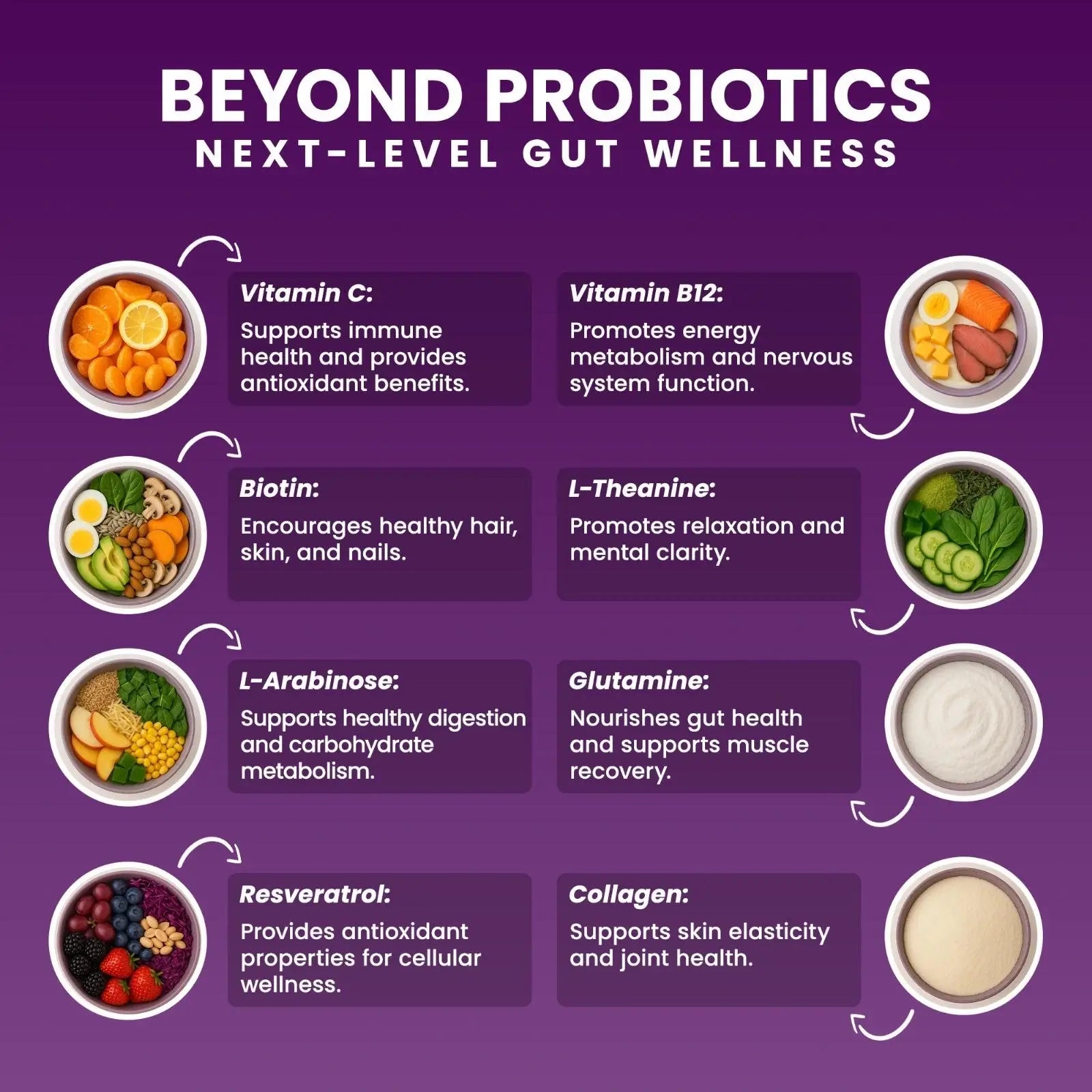
Prebiotics Explained: How They Support Gut Health, Metabolism, and GLP-1
Prebiotics: Unlocking the Secret to Optimal Health and Wellness
Introduction to Prebiotics
Prebiotics are specialized plant fibers that act as nourishment for beneficial bacteria living in your gut microbiome. Unlike probiotics, which introduce live beneficial bacteria into your system, prebiotics help feed and sustain the beneficial bacteria already present. Think of prebiotics as fertilizer for your microbiome garden—they foster the growth of beneficial microbes, enabling them to flourish and enhance your overall health (Gibson et al., 2017). If you’re exploring natural ways to improve gut health or prebiotic strategies for microbiome balance, understanding prebiotics is essential.
Anyone researching Akkermansia probiotics for metabolic wellness should understand the role prebiotics play first. Prebiotics help create the gut environment that supports beneficial microbes, SCFA production, gut barrier stability, and microbiome-driven metabolic signaling over time.
For more insights into microbiome health, visit Ali Riza Akin's blog.
The Significance of Prebiotics
The human gut is home to trillions of microorganisms that form the gut microbiota, playing critical roles in digestion, immune function, mental health, and metabolic balance.
In this broader context, GLP-1 microbiome support is best understood as an educational concept involving microbial balance, prebiotic nourishment, appetite signaling, and metabolic regulation rather than a stand-alone supplement claim.
When the microbiota is balanced and thriving, your overall health improves dramatically.
Supporting Digestive Health
Prebiotics enhance digestive health by stimulating the growth of beneficial bacteria such as Bifidobacterium and Lactobacillus species. These microbes help break down food, absorb nutrients efficiently, and maintain gut integrity, thus reducing digestive issues like bloating, constipation, and diarrhea (Slavin, 2013). For individuals looking for digestive health supplements with prebiotics, this is a foundational approach.
For readers comparing options, the best probiotic for gut lining is usually one that works alongside prebiotic fibers to support microbial balance, gut integrity, and long-term digestive resilience rather than relying on bacteria alone.
Enhancing Immune Function
Around 70% of your immune system resides in your gut. Prebiotics strengthen this system by promoting beneficial bacterial growth, thereby protecting against pathogenic bacteria and reducing inflammation (Rooks & Garrett, 2016). A well-nourished microbiome translates into fewer infections and a robust immune response. They are especially effective when integrated into immune-boosting prebiotic formulas.
Supporting Mental Health
Emerging research has revealed a critical gut-brain connection. Prebiotics improve gut microbial balance, which positively influences brain function and mood. A balanced gut microbiome can reduce symptoms of anxiety, depression, and enhance cognitive function (Cryan & Dinan, 2012). This has led to interest in gut-brain axis supplements with prebiotics for mental clarity and emotional resilience.
Metabolic Health and Weight Management
Prebiotics can also play a significant role in metabolic health. They support healthy blood sugar levels, reduce insulin resistance, and facilitate weight management by enhancing satiety and promoting fat metabolism (Delzenne & Cani, 2011). If you're seeking prebiotic supplements for weight loss and blood sugar support, this functionality is vital.

Boost Synergy GLP-1: Revolutionizing Prebiotic Supplementation
Boost Synergy GLP-1 sets itself apart from other prebiotic supplements with its meticulously selected ingredients that target specific pathways critical to gut health and metabolic functions. Its formulation is uniquely designed to support GLP-1 (Glucagon-Like Peptide-1), a hormone instrumental in regulating appetite, blood sugar control, and weight management. This makes it an advanced option for those seeking GLP-1 stimulating prebiotic supplements.
Unique Ingredients that Set Boost Synergy GLP-1 Apart
1. Akkermansia muciniphila
This beneficial bacteria species, nourished by prebiotics in Boost Synergy GLP-1, significantly impacts metabolic health. Research on Akkermansia muciniphila has increasingly examined how this bacterium relates to gut barrier integrity, inflammatory balance, insulin sensitivity, and broader metabolic health. Akkermansia supports gut barrier and intestinal lining health, reduces inflammation, and is associated with weight loss, improved insulin sensitivity, and reduced diabetes risk (Cani & de Vos, 2017). It’s one of the top microbes supported by next-generation prebiotics.
This is where akkermansia microbiome balance becomes relevant, because prebiotic support may help create the ecological conditions that allow mucus-associated microbes to contribute to barrier resilience and metabolic regulation.
2. Clostridium butyricum
A powerful probiotic species stimulated by specific prebiotics, Clostridium butyricum produces butyrate, a short-chain fatty acid crucial for gut health. Butyrate supports the intestinal lining, reduces inflammation, and enhances metabolic function, improving glucose metabolism and insulin sensitivity (Liu et al., 2015). This combination makes it part of best prebiotic-probiotic combos for metabolism.
This is why SCFAs and metabolic health are often discussed together, since short-chain fatty acids help connect prebiotic fermentation, gut barrier support, inflammation regulation, and glucose-related signaling.
This is one reason readers exploring broader topics such as leaky gut and microbiome support often become interested in butyrate-producing microbes and prebiotic strategies that reinforce barrier resilience.
3. 2’-Fucosyllactose (2’-FL HMO)
Human Milk Oligosaccharides (HMOs) like 2’-FL are natural prebiotics found in breast milk, essential for early immune development and gut colonization. This ingredient uniquely supports gut microbiota by selectively promoting beneficial bacteria and protecting against pathogens, supporting overall immunity and digestive health (Bode, 2012). One of the few HMO-based prebiotic supplements on the market.
4. Ashwagandha Root Extract
Ashwagandha, a potent adaptogen included in Boost Synergy GLP-1, helps modulate stress response, reduces inflammation, and stabilizes blood sugar levels. Its role in the formulation supports gut-brain health, connecting stress response, inflammatory balance, mental clarity, and metabolic wellness (Lopresti et al., 2019). It strengthens Boost Synergy as one of the most complete gut-brain prebiotic supplements.
This is also where stress and cravings may connect, since stress biology can influence appetite patterns, gut-brain signaling, blood sugar balance, and food choices.
How Boost Synergy GLP-1 Supports GLP-1 Secretion
GLP-1 is critical in managing appetite, insulin secretion, and weight control. Prebiotics and specific probiotics in Boost Synergy GLP-1 enhance GLP-1 production by increasing beneficial bacteria like Akkermansia muciniphila and Clostridium butyricum. These microbes stimulate enteroendocrine cells in the gut, supporting GLP-1 and microbiome signaling, improving satiety, and helping support healthy metabolism (Gribble & Reimann, 2016). These pathways are essential for those searching for natural GLP-1 support for appetite and blood sugar.
These pathways are essential for readers exploring natural GLP-1 support through appetite regulation, blood sugar balance, and microbiome-driven metabolic signaling.
This is where GLP-1 microbiome science becomes especially relevant, because prebiotic-driven microbial activity helps connect gut ecology, enteroendocrine signaling, appetite regulation, and metabolic balance.
Conclusion
Boost Synergy GLP-1 stands apart by offering an advanced, multi-dimensional prebiotic solution, providing holistic health enhancement. Whether you’re focused on digestive wellness, mental clarity, immune resilience, or metabolic balance, Boost Synergy GLP-1 is one of the most effective GLP-1 prebiotic supplements for gut health and overall vitality.
FAQ:
1. How do prebiotics differ from probiotics?
Prebiotics feed beneficial bacteria, while probiotics introduce live microbes.
The difference between prebiotics and probiotics is that prebiotics feed beneficial bacteria already living in the gut, while probiotics introduce live microbes that may support microbial balance.
2. Why are prebiotics important?
They support microbial diversity and metabolic activity in the gut.
3. What foods contain prebiotics?
Common sources include onions, garlic, bananas, oats, and other fiber-rich plant foods. These food-based GLP-1 strategies may support microbial fermentation, satiety signaling, and metabolic balance as part of a broader diet-first approach.
References:
- Gibson GR et al., Gut, 2017
Written by Ali Rıza Akın
Microbiome Scientist, Author & Founder of Next-Microbiome
Ali Rıza Akın is a microbiome scientist with nearly 30 years of experience in translational biotechnology, systems biology, and applied microbiome research, spanning discovery, preclinical development, and clinical-stage translation.
His work focuses on how microbial ecosystems interact with human physiology, including:
-
Gut barrier function and intestinal permeability
-
Mucus-associated microbiota (Akkermansia-related systems)
-
Oral–gut microbiome axis
-
Short-chain fatty acids (SCFAs) and metabolic signaling
-
Circadian rhythm–microbiome interactions
-
Clinical Research Contributions
He has contributed to multiple clinical-stage microbiome programs, supporting bacterial strain discovery, optimization, and formulation design across different therapeutic areas, including:
Active Ulcerative Colitis (Inflammatory Bowel Disease)
Hyperoxaluria (Oxalate Metabolism Disorder)
Microbiome-driven gut health and inflammatory conditions
These studies were part of broader clinical development programs evaluating microbiome-based approaches. His contributions focused on the early-stage scientific and translational pipeline, including strain discovery, functional optimization, and multi-strain formulation design.
Scientific Contributions:
Ali Rıza Akın is the discoverer of Christensenella californii, a bacterial species associated with microbiome diversity and metabolic health.
He is a contributing author to scientific publications and Bacterial Therapy of Cancer (Springer), and the author of Bakterin Kadar Yaşa: İçimizdeki Evren: Mikrobiyotamız.
Approach:
His work emphasizes evidence-based microbiome science, long-term safety, and a systems-based understanding of how microbes influence human health.
All content is provided for educational purposes only and does not replace personalized medical advice. Readers should consult qualified healthcare professionals for individual health decisions.
What Is Akkermansia Chewable? Benefits, Safety, Dosage and Evidence
Boost Synergy GLP-1 for Appetite Control, Gut Health, Blood Sugar Balance, and Mood Support
Related Posts

Why Do You Wake Up at 3 A.M.? Gut, Cortisol and Blood Sugar

Can Gut Health Affect Sleep? What Human Research Shows About the Gut Microbiome

Ozempic Plateau? What Your Gut Microbiome May Be Telling You About Slower Weight Loss

Akkermansia vs Ozempic: Why Gut Balance May Shape GLP-1 and Digestion

GLP-1 Gut Side Effects: Why Bloating and Constipation Happen and What May Help

Best Probiotic for Leaky Gut? Why Gut Barrier Support Differs From Digestive Probiotics

Can You Support Akkermansia Naturally, or Are Supplements Needed?
