


Probiotic CFU Counts: What Actually Makes a Probiotic Work Better
Introduction: Beyond CFU—The Future of Effective Probiotics
If you're shopping for a probiotic supplement, chances are you're comparing CFU counts—10 billion, 50 billion, even 100 billion. But the truth is: CFU doesn’t guarantee effectiveness.
At Next-Microbiome, our research-driven formulations prioritize what actually matters:
-
Bacterial surface area for better gut interaction
-
Efflux and influx pump efficiency for cellular survival and function
-
Metabolic activity and host communication over raw quantity
This guide will explain why CFU is an outdated metric and what to look for in truly effective, next-generation probiotics.
What is CFU—and Why It’s No Longer Enough
CFU (Colony-Forming Units) measures the number of bacteria capable of multiplying in a lab. It's useful for:
-
Ensuring a probiotic isn’t expired
-
Confirming survival during storage
But it tells you nothing about:
-
Whether the bacteria survive digestion
-
How well they colonize your gut
-
If they can reduce inflammation, produce short-chain fatty acids, or increase GLP-1 hormones
For readers comparing options, the best probiotic for gut lining is usually one evaluated by strain function, mucosal interaction, and gut barrier support rather than CFU count alone.
Common myth: Higher CFU = better probiotic
Reality: More bacteria doesn’t mean more benefit. Inactive, poorly delivered bacteria won’t work—no matter how many you consume.
The Power of Bacterial Surface Area
One of the most overlooked aspects of probiotic design is surface area—the bacterial cell’s outer layer where it interacts with your body.
Why Surface Area Matters for Gut Health:
-
More contact with intestinal and oral mucosa
-
Better immune system signaling
-
Higher nutrient absorption
-
Stronger biofilm formation (helps colonization)
-
Enhanced gut barrier integrity
Chewable Probiotics Are Better
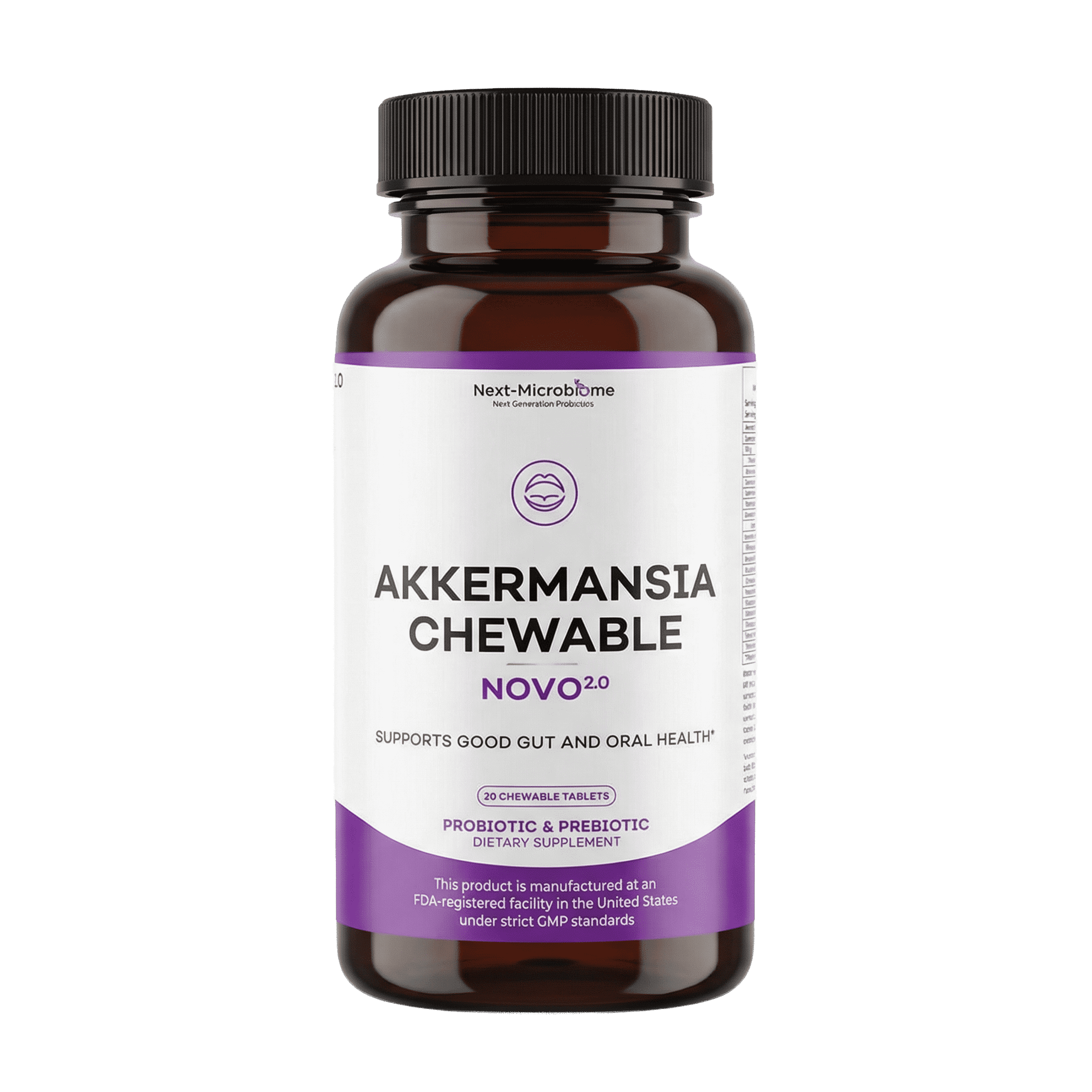
Our Akkermansia Chewable Novo 2.0 preserves bacterial surface structures by avoiding harsh capsule dissolution. This enhances bacterial activity from mouth to colon.
Influx and Efflux Pumps: The Unsung Heroes of Probiotic Science
These microscopic "transport systems" are embedded in bacterial membranes, regulating what enters and exits the cell.
Influx Pumps:
-
Absorb essential nutrients from your gut
-
Help bacteria survive and thrive
-
Improve cellular function
Efflux Pumps:
-
Expel toxins, bile acids, and even antibiotics
-
Enhance survival in hostile conditions
-
Facilitate communication with your gut and immune cells
Strains with strong pump activity have been linked to longer survival, reduced inflammation, and improved gut-brain signaling.
Metabolic Activity > Bacterial Quantity
What really matters?
The bacteria's ability to:
-
Thrive in your GI tract
-
Interact with immune cells
-
Produce beneficial compounds like butyrate, GABA, or GLP-1
-
Modulate hunger, energy levels, and mood
In that context, GLP-1 microbiome support is best understood as the result of active microbial function, metabolite signaling, and host communication, not simply a higher bacteria count.
Rather than choosing 100 billion CFU products, choose bacteria that work—like those in Next-Microbiome products.
Product Spotlight: Akkermansia Chewable Novo 2.0
Akkermansia muciniphila is one of the most researched bacteria for:
-
Lowering body fat
-
Improving glucose metabolism
-
Supporting a strong gut lining
-
Increasing GLP-1 secretion naturally
Research on Akkermansia muciniphila has increasingly focused on gut barrier integrity, metabolic signaling, inflammatory balance, and natural GLP-1 support.
But most Akkermansia products fail because the bacteria die in the stomach.
Why Our Akkermansia Works:
-
Delivered via chewable tablet → activates from oral microbiota to gut
-
Surface-optimized strain for immune interaction
-
Efflux pump-rich for survival and toxin expulsion
-
Effective at lower CFUs due to superior bioactivity
Product Spotlight: Boost Synergy GLP-1
If you're interested in natural GLP-1 support, this formula is your daily microbiome ally.
Boost Synergy GLP-1 features:
-
Clostridium butyricum for butyrate and gut barrier protection
-
Akkermansia muciniphila for GLP-1 modulation
-
Polyphenols + prebiotics to nourish active strains
-
Supports emotional balance and appetite regulation
Perfect for:
-
Metabolic health
-
GLP-1 hormone optimization
-
Natural weight management
Summary Table: CFU vs. Real Functionality
| Factor | Typical Probiotics | Next-Microbiome |
|---|---|---|
| CFU Count | 10–100 billion+ | Moderate (bioactive) |
| Delivery System | Capsule or powder | Chewable/oral route |
| Surface Area | Often degraded | Fully preserved |
| Efflux Pumps | Rarely optimized | Built into strain |
| Host Impact | Unpredictable | Clinically targeted |
| GLP-1 Effect | Minimal | Naturally activated |
Key Takeaways for Smarter Probiotic Shopping
If you're looking for probiotics that actually work, here’s what to focus on:
-
Don’t be fooled by high CFU numbers
-
Prioritize bacterial functionality
-
Look for products with surface area protection
-
Choose probiotics with influx/efflux pump activity
Your gut doesn’t need more bacteria.
It needs smarter bacteria—delivered in the right way, for the right reasons.
Next Steps: Boost Your Microbiome Today
Akkermansia Chewable Novo 2.0 →
Boost Synergy GLP-1 →
Backed by research. Built for results. Delivered intelligently.
Scientific References:
1. Surface Components & Gut Barrier (Microbial Cell Factories, 2020)
Probiotic effectiveness relies on surface molecules like proteins, flagella, and polysaccharides, enhancing gut barrier strength and modulating the immune system for improved host health.
2. Bacterial Surface Proteins & Adhesion (Frontiers in Microbiology, 2018)
Surface proteins significantly influence probiotics' ability to adhere to gut lining cells, essential for colonization, pathogen prevention, and long-term microbiome benefits.
3. Probiotic Adhesion & Gut Colonization (Biological Procedures Online, 2021)
The effectiveness of probiotics heavily depends on their adhesion mechanisms, enabling sustained gut colonization, improved immune responses, and protection against pathogens.
FAQ:
1. What should I look for on a probiotic label besides CFU count?
A stronger probiotic label should do more than list CFUs. Expert guidance suggests looking for the full organism name down to genus, species, and strain, plus a clear recommended use, serving size, storage instructions, and a use-by or expiration date. That matters because different strains within the same species can have different functions, and the label should help you identify what you are actually taking.
Scientific Reference:
https://ods.od.nih.gov/factsheets/Probiotics-HealthProfessional/
https://www.mayoclinichealthsystem.org/hometown-health/speaking-of-health/an-introduction-to-probiotics
https://isappscience.org/wp-content/uploads/2019/04/Probiotic_labeling-_rev1029-1.pdf
2. Do storage instructions and expiration dates really matter for probiotics?
Yes. Probiotics are living microorganisms, so storage and shelf life matter. Mayo Clinic Health System advises following storage instructions because some products need refrigeration, and ISAPP explains that probiotic numbers can drop during storage, which is why the use-by date is important. In practical terms, a probiotic should be evaluated by whether it remains viable through the labeled shelf life, not just by what may have been present earlier in manufacturing.
Scientific Reference:
https://www.mayoclinichealthsystem.org/hometown-health/speaking-of-health/an-introduction-to-probiotics
https://isappscience.org/wp-content/uploads/2019/04/Probiotic_labeling-_rev1029-1.pdf
3. Are more probiotic strains always better than fewer strains?
Not always. Current expert guidance does not treat probiotic quality as a simple numbers game. NIH notes that probiotic effects can be species-specific and strain-specific, Cleveland Clinic notes that different microbes function differently in the body, and Mayo Clinic Health System says there is no one-size-fits-all application because each strain may perform a separate function or offer a different benefit. A formula with fewer well-chosen strains can therefore be more meaningful than a longer label with poorly matched ones.
Scientific Reference:
https://ods.od.nih.gov/factsheets/Probiotics-HealthProfessional/
https://my.clevelandclinic.org/health/treatments/14598-probiotics
https://www.mayoclinichealthsystem.org/hometown-health/speaking-of-health/an-introduction-to-probiotics
Written by Ali Rıza Akın
Microbiome Scientist, Author & Founder of Next-Microbiome
Ali Rıza Akın is a microbiome scientist with nearly 30 years of experience in translational biotechnology, systems biology, and applied microbiome research, spanning discovery, preclinical development, and clinical-stage translation.
His work focuses on how microbial ecosystems interact with human physiology, including:
-
Gut barrier function and intestinal permeability
-
Mucus-associated microbiota (Akkermansia-related systems)
-
Oral–gut microbiome axis
-
Short-chain fatty acids (SCFAs) and metabolic signaling
-
Circadian rhythm–microbiome interactions
-
Clinical Research Contributions
He has contributed to multiple clinical-stage microbiome programs, supporting bacterial strain discovery, optimization, and formulation design across different therapeutic areas, including:
Active Ulcerative Colitis (Inflammatory Bowel Disease)
Hyperoxaluria (Oxalate Metabolism Disorder)
Microbiome-driven gut health and inflammatory conditions
These studies were part of broader clinical development programs evaluating microbiome-based approaches. His contributions focused on the early-stage scientific and translational pipeline, including strain discovery, functional optimization, and multi-strain formulation design.
Scientific Contributions:
Ali Rıza Akın is the discoverer of Christensenella californii, a bacterial species associated with microbiome diversity and metabolic health.
He is a contributing author to scientific publications and Bacterial Therapy of Cancer (Springer), and the author of Bakterin Kadar Yaşa: İçimizdeki Evren: Mikrobiyotamız.
Approach:
His work emphasizes evidence-based microbiome science, long-term safety, and a systems-based understanding of how microbes influence human health.
All content is provided for educational purposes only and does not replace personalized medical advice. Readers should consult qualified healthcare professionals for individual health decisions.
Can Your Gut Microbiome Support Natural GLP-1 Balance and Metabolic Health?
Akkermansia Benefits: Why It Matters for Gut Barrier, Metabolic Health, and Whole-Body Balance
Related Posts

Ozempic Plateau? What Your Gut Microbiome May Be Telling You About Slower Weight Loss

Akkermansia vs Ozempic: How Gut Microbiome Support May Influence GLP-1 and Digestion

GLP-1 Side Effects: How to Ease Bloating, Constipation, and Gut Issues Naturally

Best Probiotic for Leaky Gut? Why Gut Barrier Support Differs From Digestive Probiotics

Can You Support Akkermansia Naturally, or Are Supplements Needed?

GLP-1 Not Working? How Your Gut Microbiome May Be Affecting GLP-1 Signaling

What Does Science Say About Akkermansia for Gut Health?
