



GLP-1 Not Working? How Your Gut Microbiome May Be Affecting GLP-1 Signaling
Akkermansia and GLP-1
How the Gut Microbiome Influences Natural Metabolic Signaling
Understanding how Akkermansia muciniphila shapes metabolic signaling requires a broader view of its role within the gut ecosystem. Rather than acting in isolation, it operates within a complex microbial network that regulates barrier integrity, mucosal turnover, and host–microbe communication.
For readers exploring Akkermansia for gut health, this broader ecosystem view helps explain why gut lining stability, immune balance, and metabolic signaling are often discussed together.
For a deeper scientific exploration of these interconnected mechanisms, see our Akkermansia microbiome hub, where we break down how this keystone species supports gut lining stability, immune balance, and systemic metabolic signaling.
When comparing Akkermansia probiotics for metabolic wellness, it helps to understand that Akkermansia does not work as an isolated metabolic trigger. Its relevance comes from supporting mucus-layer stability, gut barrier integrity, SCFA-related microbial networks, inflammatory balance, and the upstream conditions that influence natural metabolic signaling.
Quick Answer
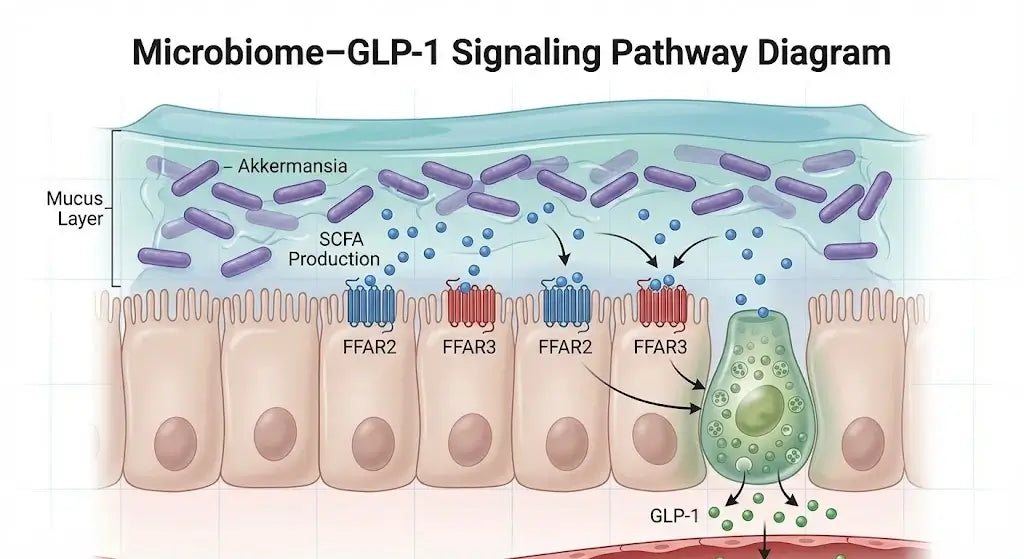
Akkermansia muciniphila does not produce GLP-1 directly. However, it supports the gut ecosystem that regulates GLP-1 secretion by supporting gut barrier and intestinal lining health, participating in short-chain fatty acid (SCFA) cross-feeding networks, and stabilizing enteroendocrine L-cell signaling environments. These upstream mechanisms influence appetite regulation and metabolic flexibility.
Does Akkermansia Increase GLP-1 Naturally?
Not directly.
It influences upstream biological conditions that regulate natural GLP-1 secretion:
-
SCFA-mediated receptor activation (FFAR2/3)
-
Mucosal barrier stability
-
Reduced inflammatory tone
-
Improved enteroendocrine cell signaling
GLP-1 is a hormone.
Akkermansia is an ecosystem regulator.
The connection is indirect — but biologically meaningful.
While the GLP-1 signaling pathway explains how Akkermansia interacts with metabolism, the real question is: what does this mean for your body in everyday life?
These mechanisms translate into a wide range of clinically observed benefits of Akkermansia muciniphila, from metabolic regulation to gut lining repair.

What Is GLP-1 — and Why Does It Matter?
GLP-1 (Glucagon-Like Peptide-1) is secreted by intestinal L-cells in response to nutrient intake.
It regulates:
-
Satiety signaling
-
Insulin secretion
-
Gastric emptying
-
Postprandial glucose response
-
Energy partitioning
This is why the idea that the microbiome controls appetite is better understood as microbiome-influenced appetite signaling, where microbial metabolites may help shape satiety, gastric emptying, and metabolic response.
Pharmacological GLP-1 receptor agonists act downstream.
Microbiome modulation acts upstream.
This is why GLP-1 and microbiome research often focuses on how microbial fermentation, gut barrier stability, and enteroendocrine signaling work together before hormone release occurs.
GLP-1 secretion is not an isolated hormonal event but part of a larger microbiome-driven signaling network involving microbial fermentation, receptor activation, and enteroendocrine communication. This upstream regulation explains why nutrient response alone cannot fully account for GLP-1 dynamics — and why the microbial ecosystem plays a foundational role in metabolic hormonal output. For a deeper breakdown of these mechanisms, explore our GLP-1 microbiome science guide.
The GLP-1 Microbiome Pathway (Simplified Flow)
Nutrient intake
↓
Microbial fermentation
↓
Short-chain fatty acids (acetate, propionate, butyrate)
↓
FFAR2/FFAR3 receptor activation
↓
Enteroendocrine L-cell stimulation
↓
GLP-1 secretion
This pathway links microbial ecology directly to hormone signaling.
While GLP-1 receptor agonists externally stimulate this pathway, the human body already possesses intrinsic mechanisms to regulate GLP-1 signaling through the gut microbiome. Certain microbial communities interact directly with intestinal L-cells, influencing the release of incretin hormones and shaping metabolic responses at a foundational level.
Among these, Akkermansia muciniphila has emerged as one of the most studied species due to its role in maintaining gut barrier integrity and supporting metabolic signaling pathways closely linked to GLP-1 activity. Rather than overriding physiology, this microbiome-driven approach enhances the body’s existing regulatory systems.
How the Microbiome Influences GLP-1
GLP-1 release is not calorie-triggered alone.
It is influenced by:
-
SCFA production
-
Barrier integrity
-
Microbial diversity
-
Inflammatory tone
-
L-cell receptor sensitivity
Inflammatory tone in particular is not always gut-generated. Disrupted sleep and chronically elevated cortisol are known upstream contributors that reduce L-cell sensitivity and dampen hormonal responsiveness. The relationship between the gut–brain–sleep axis and hormonal regulation helps explain why GLP-1 signaling capacity can vary significantly across individuals, even those with similar microbial profiles.
This also helps explain why cortisol and GLP-1 are often discussed together in metabolic health research, since stress biology may influence appetite signaling, inflammatory tone, and endocrine responsiveness.
Scientific Reference:
-
Tolhurst et al. (2012, Diabetes) demonstrated SCFA-stimulated GLP-1 secretion via FFAR2/3 signaling.
- PubMed
This established fermentation-to-hormone signaling as a biological pathway.
Where Akkermansia Fits into the GLP-1 Ecosystem

1. Mucin Layer Regulation
First described by Muriel Derrien and colleagues (2004, Int J Syst Evol Microbiol), Akkermansia muciniphila resides in the mucus layer.
Scientific Reference:
Controlled mucin turnover supports:
-
Structural L-cell positioning
-
Stable luminal signaling
-
Reduced epithelial stress
A stable mucus environment improves endocrine coordination.
2. Tight Junction Stability
Jerrold R. Turner (2009, Nat Rev Immunol) demonstrated how barrier dysfunction increases inflammatory signaling.
Scientific Reference:
Chronic low-grade inflammation reduces hormonal responsiveness.
Akkermansia abundance correlates with improved markers of metabolic inflammation (Plovier et al., 2017, Nature Medicine).
Scientific Reference:
Barrier integrity improves signaling sensitivity.
Disruption of the intestinal barrier is not only a structural issue but also a signaling problem that alters immune tone and metabolic responsiveness. Changes in gut barrier permeability can expose the host to microbial components that amplify low-grade inflammation, ultimately reducing the sensitivity of enteroendocrine signaling pathways such as GLP-1. It is also worth noting that this disruption does not always originate in the intestine. Oral dysbiosis and gut barrier disruption can trigger the same downstream cascade, as pathogenic microbial products traveling from the oral cavity into the digestive tract can further compromise the tight junction environment.
For a deeper scientific explanation of how tight junctions, mucosal integrity, and immune regulation interact, see our guide on intestinal barrier integrity and metabolic health.

3. SCFA Ecosystem Participation
Akkermansia is not a major producer of butyrate.
However, it participates in microbial cross-feeding networks that enhance SCFA ecology.
Short-chain fatty acids are not just metabolic byproducts — they function as key signaling molecules that connect microbial fermentation to host endocrine responses. Through activation of receptors such as FFAR2 and FFAR3, SCFAs directly influence GLP-1 secretion and insulin sensitivity. For a deeper scientific breakdown of how these metabolites regulate gut barrier integrity and metabolic pathways, see our short-chain fatty acids and metabolic signaling guide.
Rooks & Garrett (2016, Nat Rev Immunol) describe SCFAs as central immune-metabolic regulators.
Scientific Reference:
SCFAs directly stimulate GLP-1 secretion and improve insulin sensitivity.
Akkermansia strengthens the environment that enables this.
Mechanism Summary Table
| Mechanism | Effect on GLP-1 Pathway |
|---|---|
| Mucin renewal | Stabilizes L-cell microenvironment |
| Tight junction support | Reduces inflammatory inhibition |
| SCFA cross-feeding | Enhances GLP-1 stimulation signals |
| Barrier integrity | Improves receptor sensitivity |
| Microbial diversity | Supports hormonal coordination |
Microbial diversity is not limited to the gut alone. Across the oral–gut and gut–brain axes, diversity patterns shape immune tone, metabolic signaling, and endocrine coordination simultaneously. For a broader understanding of how these systems connect, see our Human Microbiome Hub.
Can Supporting Akkermansia Improve Metabolic Flexibility?
Metabolic flexibility refers to the body’s capacity to efficiently switch between glucose and fat oxidation in response to changes in nutrient availability or energy demand. It is a hallmark of metabolic health and reflects adaptive fuel utilization.
In a Gut (BMJ) dietary intervention study, individuals with higher Akkermansia muciniphila abundance showed improvements in metabolic markers during the intervention compared with those with lower abundance. While these observations are correlative, they align with broader patterns linking robust gut ecology with healthier metabolic adaptability and cardiometabolic regulation. Correlation does not equal causation, but the reproducibility of this association across studies suggests a meaningful connection between microbial ecosystem state and metabolic signaling environments.
Emerging research shows that Akkermansia and GLP-1 microbiome signaling play a key role in regulating metabolism and appetite.
(Study: Akkermansia muciniphila and metabolic health during a dietary intervention — Gut, BMJ)

GLP-1 Medications vs Microbiome Regulation
| GLP-1 Drugs | Microbiome Modulation |
|---|---|
| Direct receptor activation | Ecosystem-level signaling influence |
| Pharmacological appetite suppression | Endogenous pathway support |
| Immediate effect | Gradual ecological adaptation |
| Requires continuous administration | Depends on lifestyle + microbial stability |
They are not substitutes.
They operate at different biological levels.
GLP-1 is not just a molecule problem.
It is an ecosystem signaling problem.
Microbial stability itself follows a circadian pattern. Disruptions in sleep timing and feeding schedules can reduce microbial diversity and suppress SCFA production, both of which directly affect GLP-1 signaling capacity. For a deeper look at this relationship, see our guide on gut microbiome, circadian rhythm, and metabolic balance.
For readers looking at the bigger picture, gut health and longevity are often connected through long-term microbial diversity, barrier resilience, inflammatory balance, sleep consistency, and metabolic flexibility.
For readers looking for practical next steps, food-based GLP-1 strategies may also help explain how fiber intake, polyphenols, meal timing, and microbiome-supportive eating patterns can influence upstream metabolic signaling.
As the use of GLP-1 medications expands, a growing number of individuals report gastrointestinal side effects such as delayed gastric emptying, nausea, and broader shifts in digestive function. These changes highlight a critical but often overlooked factor: the underlying state of the gut microbiome. True digestive wellness and metabolic signaling are closely connected and when one is disrupted, the other often follows.
When microbial balance is compromised, metabolic signaling pathways, including those related to GLP-1, may become less stable over time. This is also why some readers exploring broader topics such as leaky gut and microbiome support become interested in strategies that help restore key bacterial populations associated with gut lining health and metabolic resilience. This has led to increasing interest in strategies that support the microbiome directly, particularly through targeted approaches that help restore key bacterial populations associated with gut lining health and metabolic resilience.
For readers looking beyond symptom patterns and toward practical next steps, a metabolic support probiotic may be worth exploring as part of a broader strategy focused on gut barrier support, microbial balance, and long-term metabolic resilience.

Is Akkermansia a Natural Alternative to GLP-1 Drugs?
Not exactly. GLP-1 medications work by directly activating hormone receptors that regulate appetite and blood sugar. Akkermansia works further upstream, supporting the gut conditions that influence how your body produces and responds to metabolic signals in the first place.
These are different mechanisms. Microbiome support is not a replacement for medical therapy, but it may complement the conditions involved in natural GLP-1 support and healthy metabolic function.
In that context, an Akkermansia probiotic may be relevant for readers who want to support mucosal integrity, SCFA ecology, and the gut conditions linked to healthy metabolic signaling.
Where Boost Synergy Fits In
Boost Synergy is formulated to support a balanced microbial environment, including mucosal integrity, short-chain fatty acid production, and gut barrier stability. Together, these factors may contribute to a gut ecosystem better equipped to support your body's natural metabolic signaling.
For readers comparing a GLP-1 probiotic supplement, Boost Synergy is best understood as a microbiome-supportive formula designed to support mucosal integrity, short-chain fatty acid production, gut barrier stability, and the broader ecosystem behind natural metabolic signaling.
For broader context on barrier integrity:
"What Is the Gut Barrier, How It Functions, and How to Support It Naturally"
For SCFA science:
"How SCFAs Support Gut Barrier, Metabolism and Microbiome Health"
Akkermansia hub:
"How Akkermansia Supports Gut Lining Health and the Oral–Gut Axis"
For readers comparing practical next steps, an Akkermansia Supplement may be worth reviewing alongside formulation quality, delivery format, and how it fits into a broader microbiome-support strategy.
Limitations of Current Research
-
Many studies are preclinical
-
Human mechanistic trials remain limited
-
Microbiome responses vary individually
-
Diet, sleep, stress, and medications influence outcomes
-
GLP-1 regulation is multi-factorial
The microbiome is one variable within a complex endocrine network.
Frequently Asked Questions
1. Does Akkermansia directly increase GLP-1 levels?
No. It supports biological pathways associated with GLP-1 regulation.
2. Do SCFAs stimulate GLP-1?
Yes. SCFAs activate receptors on L-cells that regulate GLP-1 secretion.
3. How long does microbiome-mediated support take?
Ecosystem shifts typically require weeks to months of consistent intervention.
4. Can microbiome optimization replace GLP-1 medication?
No. It influences upstream pathways but is not a pharmacological therapy.
Key Takeaways
-
GLP-1 regulation begins in the gut ecosystem
-
SCFAs stimulate GLP-1 secretion
-
Akkermansia supports barrier and mucosal stability
-
Reduced inflammation enhances hormonal sensitivity
-
Microbiome modulation acts upstream of receptor activation
Summary
Akkermansia muciniphila does not directly produce GLP-1, but it supports upstream mechanisms that regulate its secretion. By stabilizing the mucus layer, reinforcing tight junctions, and participating in SCFA cross-feeding networks, Akkermansia contributes to enteroendocrine signaling environments that influence appetite regulation and metabolic flexibility. Human research shows consistent associations between Akkermansia abundance and improved metabolic markers.
Written by Ali Rıza Akın
Microbiome Scientist, Author & Founder of Next-Microbiome
Ali Rıza Akın is a microbiome scientist with nearly 30 years of experience in translational biotechnology, systems biology, and applied microbiome research, spanning discovery, preclinical development, and clinical-stage translation.
His work focuses on how microbial ecosystems interact with human physiology, including:
-
Gut barrier function and intestinal permeability
-
Mucus-associated microbiota (Akkermansia-related systems)
-
Oral–gut microbiome axis
-
Short-chain fatty acids (SCFAs) and metabolic signaling
-
Circadian rhythm–microbiome interactions
-
Clinical Research Contributions
He has contributed to multiple clinical-stage microbiome programs, supporting bacterial strain discovery, optimization, and formulation design across different therapeutic areas, including:
Active Ulcerative Colitis (Inflammatory Bowel Disease)
Hyperoxaluria (Oxalate Metabolism Disorder)
Microbiome-driven gut health and inflammatory conditions
These studies were part of broader clinical development programs evaluating microbiome-based approaches. His contributions focused on the early-stage scientific and translational pipeline, including strain discovery, functional optimization, and multi-strain formulation design.
Scientific Contributions:
Ali Rıza Akın is the discoverer of Christensenella californii, a bacterial species associated with microbiome diversity and metabolic health.
He is a contributing author to scientific publications and Bacterial Therapy of Cancer (Springer), and the author of Bakterin Kadar Yaşa: İçimizdeki Evren: Mikrobiyotamız.
Approach:
His work emphasizes evidence-based microbiome science, long-term safety, and a systems-based understanding of how microbes influence human health.

What Does Science Say About Akkermansia for Gut Health?
Can You Support Akkermansia Naturally, or Are Supplements Needed?
Related Posts

Why Do You Wake Up at 3 A.M.? Gut, Cortisol and Blood Sugar

Can Gut Health Affect Sleep? How the Microbiome May Shape Rest and Recovery

Ozempic Plateau? What Your Gut Microbiome May Be Telling You About Slower Weight Loss

Akkermansia vs Ozempic: Why Gut Balance May Shape GLP-1, Digestion, and Results

GLP-1 Gut Side Effects: Why Bloating and Constipation Happen and What May Help

Best Probiotic for Leaky Gut? Why Gut Barrier Support Differs From Digestive Probiotics

1 Comment
Çok güzel bilgiler , teşekkür ederim