


Cortisol, Circadian Rhythm and the Microbiome Stress Loop Explained
Cortisol, Circadian Rhythm and Microbial Timing: How They Connect
Cortisol follows a daily rhythm. So, it turns out, do many of the microbes in your gut. And both of those rhythms answer to the same set of cues: light, sleep, and when you eat. When those cues are steady, the system tends to run smoothly. When they drift apart, the result can feel like being wired at night and exhausted in the morning.
This is the third post in our series on cortisol and sleep. The first two looked at the cortisol and gut connection and at how stress reshapes the gut-brain axis and sleep. Here we focus on timing: how cortisol and gut microbes appear to operate inside a shared circadian system, and what that may mean for stress, sleep, energy, and cravings. A note up front, because this is health content: much of the detailed mechanism below comes from animal studies, and the human evidence is still developing. Where a finding is from mice or rats, it is labeled as such.
Quick Answers
Do gut microbes and cortisol really share a daily rhythm? Both follow roughly 24-hour patterns, and research suggests they influence each other through meal timing, short-chain fatty acids like butyrate, and gut-brain signaling. Much of the mechanistic detail comes from animal studies, so the picture in humans is still being filled in.
Can meal and light timing affect cortisol? They appear to. Morning light helps set the central body clock that drives the natural morning cortisol rise, and a consistent daytime eating window supports the microbial rhythms tied to that clock.
Do probiotics fix cortisol timing? No supplement has been shown to fix cortisol timing in humans. Probiotics and fiber that feeds short-chain fatty acid producers may play a supporting role alongside sleep, light, and meal-timing habits, but they are not a treatment for any condition.
 Cortisol Is a Circadian Hormone, Not Only a Stress Hormone
In a healthy pattern, cortisol is high in the morning, gives you a wake-up lift, then declines across the day and reaches its lowest point at night as melatonin rises. The morning surge has a name, the Cortisol Awakening Response, and the whole curve is one of the body's main internal clocks. A detailed review by Oster and colleagues (2017) describes this 24-hour glucocorticoid rhythm and notes that it acts as a major internal synchronizer, helping keep clocks in different organs aligned (DOI).
What is less widely known is that this rhythm does not run in isolation. It is shaped by sleep, by light, and by signals coming from the gut, which is where microbial timing enters the picture.

Gut Microbes Keep Their Own Roughly 24-Hour Clock
The gut microbiome is not static across the day. Its composition and activity rise and fall on a daily cycle. In mice, Thaiss and colleagues (2014) showed that gut microbes oscillate over 24 hours, that these oscillations are driven largely by feeding times, and that disrupting the host clock or inducing jet lag throws the rhythm off and can promote dysbiosis. The same paper found comparable feeding-linked patterns in a small human sample, which is why it is one of the most cited studies in this area (DOI).
A related mouse study by Leone and colleagues (2015) went a step further, showing that microbial metabolites, especially short-chain fatty acids, feed back to influence the host's own circadian clock genes. In other words, the conversation runs both ways. (Animal study.) The practical takeaway is modest but real: microbial rhythms are sensitive to feeding windows, light and dark exposure through host hormones, stress, and sleep, so the habits that steady your clock tend to steady theirs.
Meal Timing Influences Both Microbes and Cortisol
Of all the daily cues, when you eat may be one of the strongest. Feeding time is the main driver of the microbial oscillations Thaiss and colleagues described, and it also interacts with cortisol: eating concentrated in the daytime tends to fit the natural rhythm, while heavy late-night eating pushes against it. A practical, evidence-aligned target is a consistent daytime eating window of roughly 10 to 12 hours, which gives both your hormones and your microbes a predictable pattern to settle into. A human review by Matenchuk and colleagues (2020) summarizes how gut microbes and their metabolites track the feeding and fasting cycle, and how disrupted schedules can blunt that rhythm (DOI).
SCFAs, Butyrate, and the Sleep Connection
Short-chain fatty acids, produced when gut bacteria ferment fiber, are a plausible link between microbes and the cortisol and sleep system. Butyrate is the one most often studied. In rodents, Szentirmai and colleagues (2019) found that butyrate increased non-REM sleep substantially in the hours after it was given, which points to short-chain fatty acids as one of the bacterial signals that may promote sleep (DOI). (Animal study. It measured sleep, not stress resilience, so the older framing of this finding has been corrected.)
It is fair to say that low short-chain fatty acid production is associated with weaker circadian structure and more reactive stress responses, and that feeding the bacteria that make them is sensible. It is not yet fair to say that butyrate fixes cortisol or sleep in people. The honest summary is that healthy microbes appear to support a healthier cortisol rhythm, rather than guarantee one.
How Stress Pushes Back on Microbial Timing
Stress does not only feel bad; it appears to reach into the gut. In animal models, psychological stress fairly clearly increases intestinal permeability and shifts the microbial community through mast-cell and stress-hormone pathways. In healthy humans, the picture is less settled. A 2023 review by La Torre and colleagues found that while animal data strongly suggest stress raises permeability, human studies have not produced consistent evidence, which is a useful reminder not to overstate the leaky-gut story. What the human literature does support is a reciprocal loop: poor sleep and high stress are linked with gut changes, partly through activation of the HPA axis, and those changes can feed back into sleep, as Matenchuk and colleagues describe.

The Stress Clock: One System, Several Inputs
Put together, the idea is that your stress response is not random; it is timed, and several inputs set that timing. The cortisol rhythm leans on microbial oscillation, short-chain fatty acid signals, the feeding window, the melatonin rhythm, serotonin availability, vagus-nerve tone, and the body's inflammation level. Because these are interconnected, disturbing one can nudge the others, which is how an occasional late night or skipped routine can snowball into the familiar pattern of feeling wired at night, waking around 2 to 3 a.m., dragging in the morning, and crashing in the afternoon. The strength of the links varies, and most of the precise wiring has been mapped in animals, but the overall message holds: timing matters.
A Daily Routine That May Help Realign the System
None of the following is a cure, and individual responses vary. These are low-risk habits that support a steadier cortisol and microbial rhythm, and they are where the human evidence is most encouraging.
-
Get morning light. Ten to twenty minutes of outdoor light early in the day helps set the central clock that drives the morning cortisol rise.
-
Keep a consistent daytime eating window. Aiming for roughly 10 to 12 hours of daytime eating gives microbes and hormones a predictable pattern.
-
Feed your short-chain fatty acid producers. Resistant starch, polyphenol-rich plants, and soluble fiber give gut bacteria the raw material to make butyrate.
-
Dim blue light in the evening. Less bright light at night supports melatonin and lets cortisol settle.
-
Try simple vagal activation. Slow breathing, humming, or brief cold exposure may support a calmer stress-recovery state.
-
Keep regular sleep and wake times. Predictable host cues are what microbial and hormonal rhythms realign to.
One honest caveat on sleep: a controlled human study by Karl and colleagues (2023) found that several nights of severe sleep restriction reduced gut microbiome richness but did not measurably increase intestinal permeability. So while sleep clearly matters for the microbiome, the popular claim that one bad night breaks the gut barrier is stronger than the current human evidence.
Where Akkermansia and Sleepy-Biome Fit
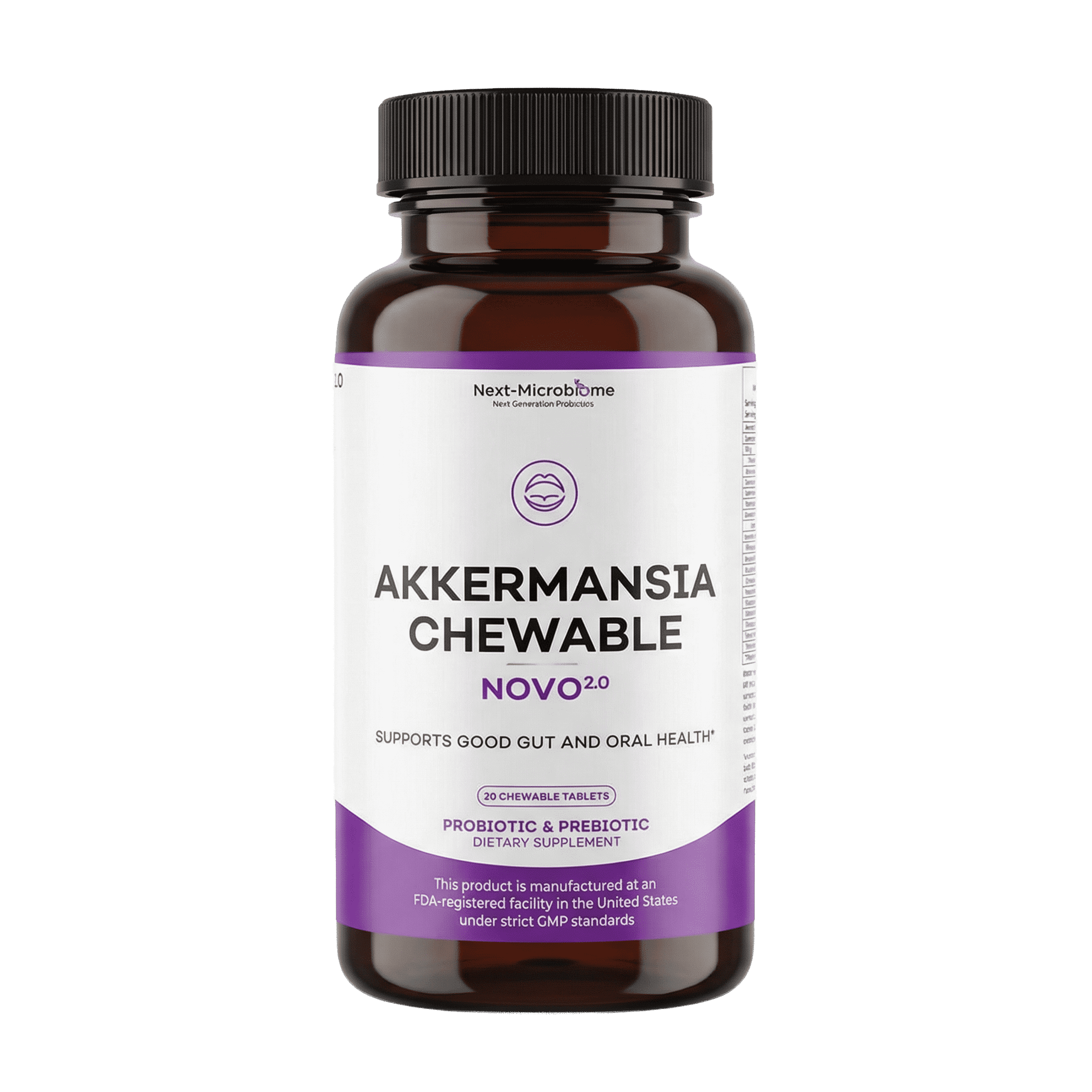
Within this routine, two of our formulas are designed to play a supporting role rather than to override the body's own timing. Akkermansia Chewable is formulated to support mucosal health and the oral-gut signaling pathway, an area of active research. Sleepy-Biome is a melatonin-free probiotic formula intended to support the gut side of the sleep and stress picture. Neither is a treatment for insomnia, stress, or any medical condition, and both work best as one part of the light, meal-timing, and sleep habits above. If you are weighing options, the most useful question is whether a product supports short-chain fatty acid production and gut-barrier integrity, not whether it promises a quick fix.
For more background, see our deeper guides on restoring Akkermansia and on overall gut health, and the earlier posts in this series on the cortisol and gut connection, on stress and sleep, on short-chain fatty acids and stress recovery, and on cortisol, cravings, and GLP-1:
Cortisol & Gut Microbiome: The Hidden Stress Loop Explained
Stress, Gut–Brain Axis & Sleep: Microbiome Disruption
Cortisol, Circadian Rhythm & Microbial Timing Explained
SCFAs & Stress Recovery: Restore Gut, Calm HPA Axis
Cortisol, Cravings & GLP-1: How Stress Hijacks Appetite
Frequently Asked Questions
1. How does cortisol follow a circadian rhythm?
Cortisol typically peaks in the morning, in what is called the Cortisol Awakening Response, then declines across the day to a nighttime low. This pattern is governed by the body's central clock and the HPA axis, and it is described in detail by Oster and colleagues (2017).
2. Do gut microbes really have their own daily clock?
Research in mice shows gut microbes oscillate over roughly 24 hours, shaped mainly by feeding times, with light, hormones, and stress also playing a part. A small human component of the same work showed similar feeding-linked patterns, though the human picture is still developing.
3. How does late-night eating affect cortisol and sleep?
Eating heavily late at night runs against the natural rhythm and may raise evening cortisol and disturb sleep. Concentrating food in a consistent daytime window, often around 10 to 12 hours, helps both hormonal and microbial timing settle, based on feeding-rhythm studies.
4. Can low SCFA levels affect circadian rhythm?
Short-chain fatty acids such as butyrate are signaling molecules that, in animal studies, feed back onto the body's clock genes and onto sleep. Low production is associated with weaker circadian structure and more reactive stress, though most of this mechanism has been mapped in animals so far.
5. How does stress affect gut microbes?
In animal models, stress fairly clearly shifts the microbial community and increases gut permeability through stress-hormone and immune pathways. In healthy humans the evidence is mixed, as a 2023 review by La Torre and colleagues found, so the relationship is real but should not be overstated.
6. What are the signs that cortisol timing may be off?
Feeling wired but tired, waking around 2 to 3 a.m., morning exhaustion, afternoon crashes, evening anxiety, and unpredictable energy may reflect a disrupted cortisol and circadian pattern. These are nonspecific, though, and persistent symptoms are worth discussing with a clinician rather than self-diagnosing.
7. Does poor sleep affect the gut microbiome?
It can. A human study by Karl and colleagues (2023) found that several nights of severe sleep restriction reduced microbiome richness, although it did not measurably change intestinal permeability. Sleep clearly matters for the microbiome, but the idea that a single bad night breaks the gut barrier goes beyond the current human evidence.
8. How does light exposure influence the body clock?
Morning light helps set the central clock that drives the cortisol rise, while bright or blue-rich light at night can suppress melatonin and push cortisol later. Getting light early and dimming it in the evening are simple ways to support the rhythm.
9. What role does the vagus nerve play?
The vagus nerve is a major communication line between the gut and brain and contributes to HPA-axis regulation and stress recovery. Much of the detailed signaling has been studied in animals, so vagal tone is best thought of as one supporting factor in stress and circadian balance, not a switch you can flip.
10. Do probiotics help fix cortisol timing?
No probiotic has been shown to fix cortisol timing in humans. Strains and foods that support short-chain fatty acid production, gut-barrier integrity, and microbial balance may play a supporting role, but they work alongside sleep, light, and meal-timing habits rather than replacing them.
11. What daily habits may help realign cortisol and microbial rhythm?
Morning light, a consistent daytime eating window, fiber that feeds short-chain fatty acid producers, less evening blue light, gentle vagal activation such as slow breathing, and regular sleep and wake times are all low-risk habits that may support a steadier rhythm over time.
References
-
Oster H, Challet E, Ott V, et al.
The Functional and Clinical Significance of the 24-Hour Rhythm of Circulating Glucocorticoids
Endocrine Reviews 2017;38(1):3-45. DOI. (Human review.) -
Leone V, Gibbons SM, Martinez K, et al.
Effects of Diurnal Variation of Gut Microbes and High-Fat Feeding on Host Circadian Clock Function and Metabolism
Cell Host & Microbe 2015;17(5):681-689 (Animal study) -
Thaiss CA, Zeevi D, Levy M, et al.
Transkingdom Control of Microbiota Diurnal Oscillations Promotes Metabolic Homeostasis
Cell. 2014;159(3):514-529. DOI. (Animal study with a small human component) -
Szentirmai E, Millican NS, Massie AR, Kapas L.
Butyrate, a metabolite of intestinal bacteria, enhances sleep
Scientific Reports 2019;9(1):7035. DOI. (Animal study, NREM sleep) -
Matenchuk BA, Mandhane PJ, Kozyrskyj AL.
Sleep, circadian rhythm, and gut microbiota
Sleep Medicine Reviews. 2020;53:101340. DOI. (Human review) -
Karl JP, Whitney CC, Wilson MA, et al.
Severe, short-term sleep restriction reduces gut microbiota community richness but does not alter intestinal permeability in healthy young men
Scientific Reports 2023;13:213 (Human study) -
La Torre D, Van Oudenhove L, Vanuytsel T, Verbeke K.
Psychosocial stress-induced intestinal permeability in healthy humans: What is the evidence?
Neurobiology of Stress 2023;27:100579 (Human review)
Written by Ali Rıza Akın
Microbiome Scientist, Author & Founder of Next-Microbiome
Ali Rıza Akın is a microbiome scientist with nearly 30 years of experience in translational biotechnology, systems biology, and applied microbiome research, spanning discovery, preclinical development, and clinical-stage translation.
His work focuses on how microbial ecosystems interact with human physiology, including:
-
Gut barrier function and intestinal permeability
-
Mucus-associated microbiota (Akkermansia-related systems)
-
Oral–gut microbiome axis
-
Short-chain fatty acids (SCFAs) and metabolic signaling
-
Circadian rhythm–microbiome interactions
-
Clinical Research Contributions
He has contributed to multiple clinical-stage microbiome programs, supporting bacterial strain discovery, optimization, and formulation design across different therapeutic areas, including:
Active Ulcerative Colitis (Inflammatory Bowel Disease)
Hyperoxaluria (Oxalate Metabolism Disorder)
Microbiome-driven gut health and inflammatory conditions
These studies were part of broader clinical development programs evaluating microbiome-based approaches. His contributions focused on the early-stage scientific and translational pipeline, including strain discovery, functional optimization, and multi-strain formulation design.
Scientific Contributions:
Ali Rıza Akın is the discoverer of Christensenella californii, a bacterial species associated with microbiome diversity and metabolic health.
He is a contributing author to scientific publications and Bacterial Therapy of Cancer (Springer), and the author of Bakterin Kadar Yaşa: İçimizdeki Evren: Mikrobiyotamız.
Approach:
His work emphasizes evidence-based microbiome science, long-term safety, and a systems-based understanding of how microbes influence human health.
Medical Disclaimer
This content is for educational and informational purposes only and is not medical advice. It is not intended to diagnose, treat, cure, or prevent any disease, including insomnia or other sleep disorders, chronic stress, or any hormonal condition. Dietary supplements are not a substitute for prescription medication or professional care. Consult a qualified healthcare professional before making changes to your diet, supplement routine, sleep, or treatment, especially if you are pregnant, nursing, managing a health condition, or taking medication.

Stress and Sleep: How the Gut-Brain Axis Disrupts Rest and Recovery
How SCFAs Support Stress Recovery, Gut Integrity, and HPA Axis Balance
Related Posts

Why Do You Wake Up at 3 A.M.? Gut, Cortisol, Blood Sugar, and Sleep Recovery

Can Gut Health Affect Sleep? How the Microbiome May Shape Rest and Recovery

Ozempic Plateau? What Your Gut Microbiome May Be Telling You About Slower Weight Loss

Akkermansia vs Ozempic: Why Gut Balance May Shape GLP-1, Digestion, and Results

GLP-1 Side Effects: How to Ease Bloating, Constipation, and Gut Issues Naturally

Best Probiotic for Leaky Gut? Why Gut Barrier Support Differs From Digestive Probiotics

Can You Support Akkermansia Naturally, or Are Supplements Needed?
