
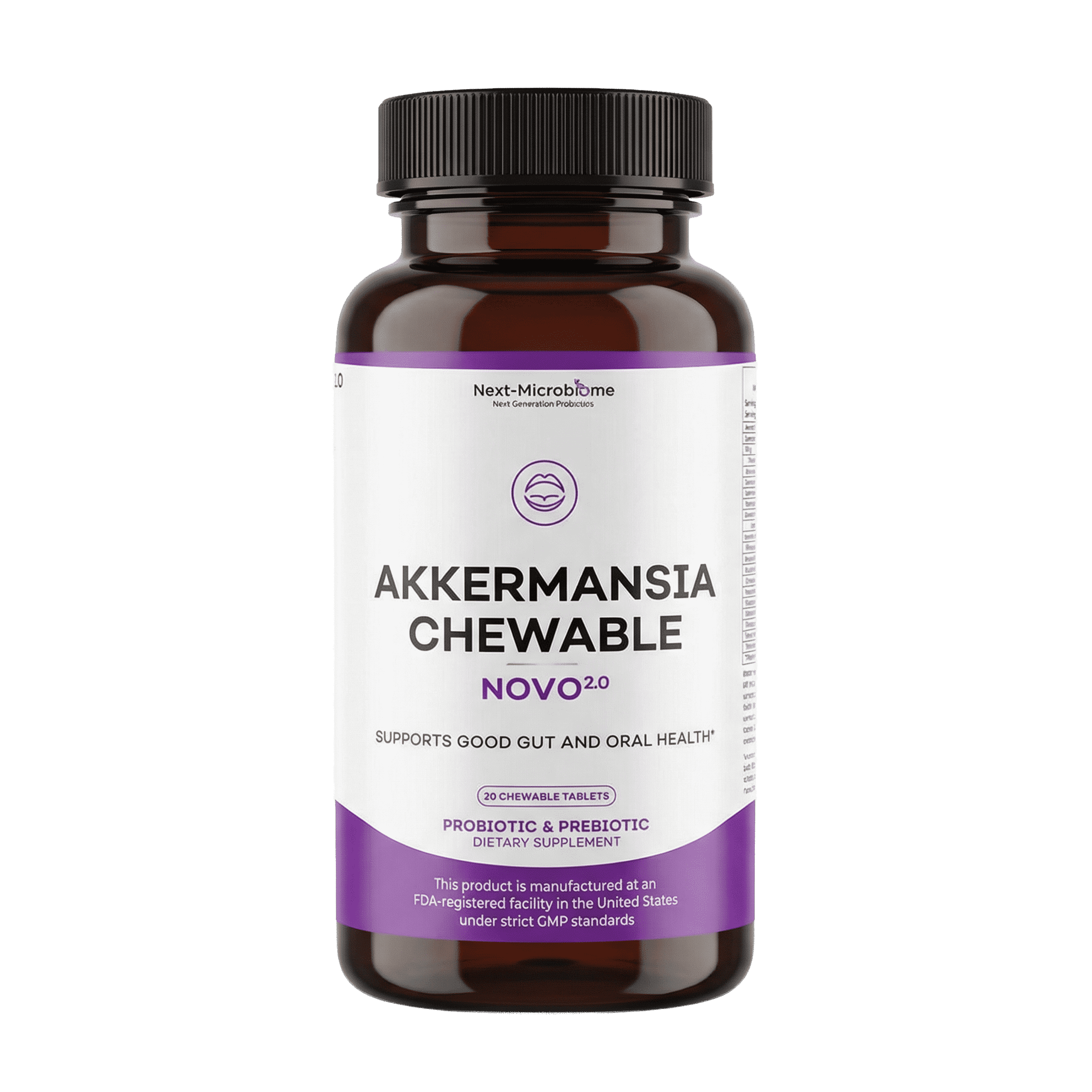


Akkermansia Benefits: Why It Matters for Gut Barrier, Metabolic Health, and Whole-Body Balance
What Is Akkermansia muciniphila, and What Are Its Benefits for Gut and Metabolic Health?
Akkermansia muciniphila has become one of the most studied bacteria in the human gut, and for good reason. It was first isolated in 2004 by microbiologist Muriel Derrien, and since then research has connected it to gut barrier function, metabolic health, and the way the gut communicates with the rest of the body. Much of that research is still early, and a fair amount comes from animal models, so this article tries to separate what is reasonably well supported from what remains promising but unproven.
If you are comparing an Akkermansia muciniphila supplement against a conventional digestive probiotic, the useful distinction is where each one acts. Many probiotics work mainly in the gut lumen. Akkermansia lives in and feeds on the mucus layer, which is why it tends to come up in discussions of barrier integrity, inflammatory balance, and broader host-microbiome signaling rather than digestion alone.
Quick Answers
What is Akkermansia muciniphila? A mucus-associated gut bacterium that degrades mucin and, in doing so, appears to help maintain the mucus layer and gut barrier. It is naturally present in most healthy people.
What are its main potential benefits? The most consistent research signals are around gut barrier support and metabolic markers. Findings on inflammation, the gut-brain axis, and aging are mostly preclinical and should be read as early.
Can you raise Akkermansia levels? Diet seems to help. Fermentable fibers like inulin and polyphenol-rich plant foods are associated with higher Akkermansia in human and laboratory studies, though no single food guarantees a rise.
What Akkermansia muciniphila Is, and Where It Lives
Akkermansia makes up a meaningful share of the gut bacteria in many healthy adults. It specializes in breaking down mucins, the proteins that form the gut’s protective mucus layer. That sounds counterproductive, but this controlled turnover appears to stimulate fresh mucus production and help keep the barrier intact. Lower Akkermansia abundance is one of the more repeatable patterns associated with obesity and metabolic dysfunction in human studies, which is part of why it draws so much interest.
What the Research Suggests About Akkermansia
The sections below group the evidence by how strong it currently is. Where a finding comes from animals, that is stated plainly.
1. Gut barrier and the mucus layer
This is the best-developed area. In mouse studies, Akkermansia supported mucus thickness and barrier integrity, and mechanistic work has linked it to tight-junction support. Human data are still catching up, but the barrier story is the most biologically grounded reason Akkermansia is described as a keystone species. For more on how the lining itself works, see our gut barrier and intestinal permeability guide.
2. Inflammation and short-chain fatty acids
Akkermansia is associated with a healthier inflammatory environment in the gut, partly through its interaction with the mucus layer and its place in a community that produces short-chain fatty acids such as butyrate. Butyrate is a primary fuel for colon cells and supports barrier resilience. Most of the direct anti-inflammatory evidence is preclinical and strain-specific, so this is best read as a plausible mechanism rather than a proven clinical effect.
3. Metabolic health: weight, insulin sensitivity, and lipids
This is where human evidence exists, though it is modest. A small, exploratory proof-of-concept study in overweight and obese adults found that daily Akkermansia supplementation over three months was safe and was associated with some improvements in metabolic markers, including insulin sensitivity (Depommier et al., 2019, Nature Medicine: PubMed). It was not a large trial and did not establish weight loss as an outcome. A metabolic support probiotic is therefore best seen as one supportive piece alongside diet and lifestyle, not a treatment for any metabolic condition.
4. The gut-brain axis and mood
Akkermansia is sometimes mentioned in gut-brain discussions because the microbiome communicates with the brain through immune, metabolic, and neural pathways (Cryan et al., 2019, Physiological Reviews: journal). That review is largely built on animal data and does not show that probiotics treat anxiety or depression. For mood, this is an early and indirect signal, not a clinical claim.
5. Aging research
In a study of accelerated-aging mice, Akkermansia supplementation improved colonic mucus thickness and dampened some immune activation (van der Lugt et al., 2019, Immunity & Ageing: journal). These are mouse findings about a single barrier-related mechanism, not evidence of anti-aging effects in people.
6. Immune function and a note on cancer research
By supporting microbial balance and the barrier, Akkermansia may contribute to a more regulated immune environment, though this too is largely preclinical. Akkermansia has appeared in cancer research, but in a specific context: higher abundance has been associated with better response to certain immunotherapies in some patients, which is not the same as preventing cancer. Any cancer-related framing should stay in that narrow, accurate lane.
Increasing Akkermansia Levels Naturally
Diet is the most practical lever. A systematic review found that fermentable fibers such as inulin, along with caloric restriction and several plant compounds, were associated with higher Akkermansia, while a low-FODMAP pattern was associated with lower levels (Verhoog et al., 2019, Nutrients: PubMed). Polyphenol-rich foods may help as well, in part by shaping the gut’s chemical environment in a way that favors Akkermansia growth (Van Buiten et al., 2024, Antioxidants: PubMed). For practical food strategies, see our guide on foods that increase Akkermansia.
Supplements, including chewable formats, are also studied, but the evidence on which format colonizes best is still developing, so claims of optimized colonization should be treated cautiously. Whatever the format, a probiotic is one input into a larger system that also depends on fiber, plant diversity, and consistency over time.

A Note on Supplements and Safety
Early human research is encouraging on safety. The proof-of-concept study above reported that supplementation was well tolerated over three months, and later reviews have described pasteurized Akkermansia as having a favorable safety profile in the groups studied so far. Even so, the NIH Office of Dietary Supplements and NCCIH advise discussing probiotics with a healthcare professional, especially for anyone with a serious illness, a weakened immune system, or questions about product quality.
Future Research and Potential
Work on Akkermansia continues across gut barrier function, metabolic regulation, and the broader microbiome. The honest summary today is that the barrier and metabolic signals are the most developed, while much of the rest is promising and preclinical. That is a reasonable place for an interested reader to stand.
Frequently Asked Questions
1. What foods help increase Akkermansia muciniphila naturally?
Prebiotic fiber is the most practical starting point. The Cleveland Clinic notes that prebiotics feed helpful gut microbes, and human-focused research suggests that soluble fibers such as inulin, along with polyphenol-rich plant foods, may raise Akkermansia abundance. No single food guarantees a rise, so the better strategy is a consistent pattern of fiber-rich, plant-diverse eating.
Medical Reference:
https://health.clevelandclinic.org/what-are-prebiotics
https://my.clevelandclinic.org/health/body/25201-gut-microbiome
Scientific Reference:
https://pubmed.ncbi.nlm.nih.gov/31336737/
https://pubmed.ncbi.nlm.nih.gov/38539838/
2. Is Akkermansia muciniphila safe as a supplement?
Early human research is encouraging. A 2019 proof-of-concept study in overweight and obese adults found daily supplementation safe and well tolerated over three months, and later reviews describe pasteurized Akkermansia as having a favorable safety profile in the groups studied so far. The NIH and NCCIH still advise discussing probiotics with a healthcare professional, especially with a serious illness, a weakened immune system, or questions about product quality.
Medical Reference:
https://ods.od.nih.gov/factsheets/Probiotics-HealthProfessional/
https://www.nccih.nih.gov/health/probiotics-usefulness-and-safety
Scientific Reference:
https://pubmed.ncbi.nlm.nih.gov/31263284/
https://www.nature.com/articles/s41522-022-00338-4
3. What can lower Akkermansia levels in the gut?
An unhealthy gut environment tends to work against it. Reviews report lower Akkermansia abundance in obesity and high-fat-diet models, and human studies link lower levels with obesity and poorer metabolic markers. A systematic review also found that a low-FODMAP diet was associated with reduced Akkermansia. Separately, the Cleveland Clinic notes that antibiotics can disrupt the microbiome by killing beneficial bacteria along with harmful ones, so unnecessary antibiotic use may make recovery harder.
Medical Reference:
https://ods.od.nih.gov/factsheets/Probiotics-HealthProfessional/
https://www.nccih.nih.gov/health/probiotics-usefulness-and-safety
Scientific Reference:
https://pubmed.ncbi.nlm.nih.gov/31263284/
https://www.nature.com/articles/s41522-022-00338-4
References
-
Cleveland Clinic.
What Are Prebiotics and What Do They Do? Cleveland Clinic Health Essentials. -
Cleveland Clinic.
Gut Microbiome. Cleveland Clinic Health Library -
Depommier C, et al.
Supplementation with Akkermansia muciniphila in overweight and obese human volunteers: a proof-of-concept exploratory study.
Nature Medicine. 2019;25(7):1096-1103. DOI -
Rational consideration of Akkermansia muciniphila targeting intestinal health: advantages and challenges.
npj Biofilms and Microbiomes. 2022;8:81. DOI -
NIH Office of Dietary Supplements.
Probiotics: Health Professional Fact Sheet -
National Center for Complementary and Integrative Health
Probiotics: Usefulness and Safety -
Verhoog S, et al.
Dietary Factors and Modulation of Bacteria Strains of Akkermansia muciniphila and Faecalibacterium prausnitzii: A Systematic Review.
Nutrients. 2019;11(7):1565. DOI -
Van Buiten CB, Seitz VA, Metcalf JL, Raskin I.
Dietary Polyphenols Support Akkermansia muciniphila Growth via Mediation of the Gastrointestinal Redox Environment.
Antioxidants (Basel). 2024;13(3):304. DOI -
Cryan JF, O’Riordan KJ, Cowan CSM, et al.
The Microbiota-Gut-Brain Axis.
Physiological Reviews. 2019;99(4):1877-2013 DOI -
van der Lugt B, et al.
Akkermansia muciniphila ameliorates the age-related decline in colonic mucus thickness and attenuates immune activation in accelerated aging Ercc1 mice. Immunity & Ageing. 2019;16:6 DOI
Written by Ali Rıza Akın
Microbiome Scientist, Author & Founder of Next-Microbiome
Ali Rıza Akın is a microbiome scientist with nearly 30 years of experience in translational biotechnology, systems biology, and applied microbiome research, spanning discovery, preclinical development, and clinical-stage translation.
His work focuses on how microbial ecosystems interact with human physiology, including:
-
Gut barrier function and intestinal permeability
-
Mucus-associated microbiota (Akkermansia-related systems)
-
Oral–gut microbiome axis
-
Short-chain fatty acids (SCFAs) and metabolic signaling
-
Circadian rhythm–microbiome interactions
-
Clinical Research Contributions
He has contributed to multiple clinical-stage microbiome programs, supporting bacterial strain discovery, optimization, and formulation design across different therapeutic areas, including:
Active Ulcerative Colitis (Inflammatory Bowel Disease)
Hyperoxaluria (Oxalate Metabolism Disorder)
Microbiome-driven gut health and inflammatory conditions
These studies were part of broader clinical development programs evaluating microbiome-based approaches. His contributions focused on the early-stage scientific and translational pipeline, including strain discovery, functional optimization, and multi-strain formulation design.
Scientific Contributions:
Ali Rıza Akın is the discoverer of Christensenella californii, a bacterial species associated with microbiome diversity and metabolic health.
He is a contributing author to scientific publications and Bacterial Therapy of Cancer (Springer), and the author of Bakterin Kadar Yaşa: İçimizdeki Evren: Mikrobiyotamız.
Approach:
His work emphasizes evidence-based microbiome science, long-term safety, and a systems-based understanding of how microbes influence human health.
Medical Disclaimer
This content is for educational and informational purposes only and is not medical advice. It is not intended to diagnose, treat, cure, or prevent any disease. Dietary supplements are not a substitute for prescription medication or professional care. Consult a qualified healthcare professional before making changes to your diet, supplement routine, or treatment, especially if you are pregnant, nursing, managing a health condition, or taking medication.
Probiotic CFU Counts: What Actually Makes a Probiotic Work Better
Are Chewable Probiotics Better Than Capsules for Gut Health and the Oral-Gut Axis?
Related Posts

Why Do You Wake Up at 3 A.M.? Gut, Cortisol, Blood Sugar, and Sleep Recovery

Can Gut Health Affect Sleep? How the Microbiome May Shape Rest and Recovery

Ozempic Plateau? What Your Gut Microbiome May Be Telling You About Slower Weight Loss

Akkermansia vs Ozempic: Why Gut Balance May Shape GLP-1, Digestion, and Results

GLP-1 Gut Side Effects: Why Bloating and Constipation Happen and What May Help

Best Probiotic for Leaky Gut? Why Gut Barrier Support Differs From Digestive Probiotics

Can You Support Akkermansia Naturally, or Are Supplements Needed?
