


Akkermansia for Kids: Building a Stronger Gut Microbiome From the Start
Akkermansia for Kids — Building a Stronger Microbiome from the Start
Every child carries a hidden universe inside them — a living ecosystem of bacteria that shapes not only their digestion but also their immune system, mood, and focus. Among these countless microbes, one stands out as a true guardian of balance and resilience: Akkermansia muciniphila.
Recent scientific studies have revealed that this single bacterium plays a central role in children’s gut health (Next-Microbiome research on Akkermansia shows similar early-life protective mechanisms may already be active during childhood), acting like a natural shield that protects the gut lining, reduces inflammation, and trains the immune system during early life.
Frequently Asked Questions — Akkermansia, Child Development & Gut Health
Akkermansia muciniphila science continues to explore how this bacterium relates to gut barrier and intestinal lining health, immune balance, and early-life microbiome resilience.
For parents who want a broader foundation before focusing on Akkermansia, our gut health microbiome guide explains how diet, microbial diversity, gut barrier support, sleep, and daily habits influence digestive wellness.
For parents researching where to buy Akkermansia muciniphila, it is important to remember that children’s microbiome support should begin with diet quality, fiber diversity, sleep, outdoor play, and pediatric guidance. Any supplement should be evaluated based on age-appropriate use, formulation quality, and whether it complements the child’s overall routine.
1. What makes Akkermansia so important for children?
Akkermansia strengthens the gut barrier, trains the developing immune system, reduces inflammation, and supports digestion during early growth.
2. When does Akkermansia begin forming in a child’s gut?
Akkermansia levels rise gradually in infancy as the mucin layer develops and stabilize throughout early childhood.
3. How does Akkermansia protect the gut lining?
It lives in the mucin layer, stimulates mucin renewal, and maintains tight junctions—making the gut barrier stronger and more resilient.
4. Can low Akkermansia contribute to inflammation in kids?
Yes — lower levels are associated with increased inflammatory markers, weaker gut integrity, and reduced immune balance.
5. Which foods naturally help increase Akkermansia in children?
Berries, oats, apples, beans, cocoa (low sugar), nuts/seeds (age appropriate), and polyphenol-rich fruits support its growth.
6. How does Akkermansia influence a child’s immune system?
It helps the immune system distinguish danger from safety, reduces unnecessary inflammation, and supports healthy immune maturation.
7. Can antibiotics reduce Akkermansia levels in children?
Yes — antibiotics can temporarily lower Akkermansia and weaken the mucin layer, making dietary recovery especially important afterward.
8. Is Akkermansia linked to better metabolic health in kids?
Emerging research shows higher Akkermansia correlates with improved metabolic markers, healthier glucose handling, and lower inflammation.
For educational context, GLP-1 and microbiome research may help explain how gut microbes, microbial metabolites, and appetite-related signaling are connected, but this should not be framed as a weight-loss claim for children.
9. Can picky eating affect Akkermansia growth?
Yes — limited fiber and low plant diversity restrict the prebiotics Akkermansia depends on, slowing microbial development.
10. How does sleep affect Akkermansia and the microbiome?
The connection between microbiome and sleep matters because consistent sleep supports healthy circadian rhythms, SCFA production, and gut barrier renewal, indirectly supporting Akkermansia levels.
11. Can stress impact a child’s Akkermansia levels?
Yes — stress alters cortisol rhythms, reduces microbial diversity, and weakens the mucin layer that Akkermansia maintains.
12. Are fermented foods helpful for increasing beneficial microbes?
Yes — age-appropriate servings of yogurt, kefir, or fermented vegetables help diversify the microbiome and support mucosal health.
13. What are signs that a child may have low microbial diversity?
Frequent digestive upset, sugar cravings, poor sleep, skin irritation, repeated infections, or increased inflammation.
Patterns such as stress and cravings can also overlap with sleep disruption, inflammation, and diet quality, so they should be viewed as broad wellness signals rather than proof of one specific microbiome issue.
14. Does sugar reduce Akkermansia in kids?
Yes — excessive sugar thins the mucin layer, increases inflammatory bacteria, and suppresses Akkermansia populations.
15. Can improving Akkermansia support emotional or cognitive development?
Potentially — by reducing inflammation and supporting gut–brain communication, Akkermansia contributes to stable mood and better focus.
16. Are probiotics necessary for supporting Akkermansia in children?
Not always. Many kids improve with food diversity, polyphenols, and fiber. But synbiotics and chewable probiotics that support gut barrier health may enhance Akkermansia-friendly conditions when they fit a child’s age and routine. For parents comparing options, the best probiotic for gut lining is usually one that complements food diversity rather than replacing it.

17. How long does it take to strengthen a child’s microbiome?
Most children show improvements in 2–4 weeks, with deeper Akkermansia recovery happening over 6–12 weeks.
18. How does the mucin layer develop in childhood?
It grows thicker and more structured during early childhood, providing the habitat where Akkermansia thrives and supports natural gut lining repair and resilience.
19. Can diet really reshape the microbiome long-term?
Yes — diets rich in whole foods, fiber, and polyphenols create lasting positive shifts in Akkermansia and overall microbial resilience.
20. What simple daily habits support Akkermansia from the start?
Colorful fruits and vegetables, consistent sleep, outdoor play, hydration, lower sugar intake, and a fiber-rich breakfast.
Unlock the gut-hormone secret to metabolic health, "How GLP-1 and the Gut Microbiome Support Metabolism and Weight Management."
For parents who want broader educational context, a GLP-1 probiotic formula should be viewed through gut-hormone signaling, microbial metabolites, and metabolic health research, not as a child-focused weight-loss solution.
Why Akkermansia Matters for Children’s Gut Health
Akkermansia lives in the protective mucin layer of the intestines — the barrier that separates the inner microbial world from the child’s bloodstream.
When Akkermansia thrives:
-
The gut wall becomes stronger, which is one reason intestinal permeability science is often discussed in relation to Akkermansia, mucin renewal, and gut barrier resilience.
-
Harmful bacteria and toxins are kept out.
-
The immune system learns what’s safe and what’s dangerous.
-
Nutrient absorption and metabolism stay efficient.
Low Akkermansia levels have been associated with increased inflammation and poorer metabolic markers in children, especially those consuming diets high in processed foods and low in fiber. In that broader context, some researchers also examine the GLP-1 microbiome connection as part of how gut microbes may influence metabolic regulation.
For parents who want to explore the science further, GLP-1 microbiome support is best framed here as an educational topic about microbial and metabolic signaling, not as a weight-loss claim or the primary reason to choose a child-focused gut health product.
Reference: (Ayala-García et al., 2023)
For a deeper dive into how modern eating patterns disrupt this delicate balance, explore:
How Modern Diets Harm Kids' Gut Health
Does boosting Akkermansia really help kids?
Reported Akkermansia muciniphila benefits in children are often discussed in relation to:
-
Lower inflammation
-
Stronger gut barrier function
-
Improved metabolic resilience
Supporting this microbe through diet and targeted synbiotics promotes a more balanced internal environment during growth.
How Akkermansia Shapes Immunity and Brain Development
In early life, a child’s microbiome sends chemical signals that guide immune cell education and brain development.
Higher Akkermansia levels are linked to:
-
More balanced immune responses
-
Improved glucose regulation
-
Enhanced neuroplasticity — the brain’s ability to adapt and learn
Akkermansia strengthens the mucosal barrier and helps control systemic inflammation, two key factors influencing gut-brain health during childhood development.
Emerging research suggests that intact mucosal biology, supported by Akkermansia, reduces neuroinflammation and supports emotional stability and focus.
Reference: (Xu R et al., 2023)
If you want to understand how the microbiome shapes learning and attention, see:
Healthy Microbiome, Kids’ Focus & Chewable Akkermansia
Can Akkermansia affect learning and behavior?
Research exploring the microbiota–gut–brain connection describes Akkermansia as a regulator of inflammatory signals that affect:
-
Mood
-
Cognitive speed
-
Neuroplasticity
While Akkermansia is not a treatment for behavioral conditions, supporting this microbe contributes to a healthier internal environment for learning and emotional balance.
The Early Years: A Critical Window for Microbiome Formation
The first 1,000 days of life are foundational for shaping gut ecology.
Factors influencing Akkermansia development include:
-
Mode of birth
-
Breastfeeding duration
-
Antibiotic exposure
-
Diversity of early diet (fruits, vegetables, polyphenols)
Even if early disruptions occurred, Akkermansia remains highly responsive to diet and next-generation synbiotics later in childhood.

Is it too late to support Akkermansia if my child is older?
No — Akkermansia responds dynamically to lifestyle and nutritional patterns throughout childhood.
Natural Ways to Support Akkermansia in Kids
Science-backed ways to help Akkermansia flourish:
-
Offer colorful, polyphenol-rich foods: berries, apples, pomegranate, leafy greens.
-
Include fermented foods for older children.
-
Limit added sugars and ultra-processed snacks.
-
Encourage outdoor play, pets, and nature exposure.
-
Add targeted synbiotics containing Akkermansia muciniphila.
Polyphenol-rich diets have consistently been shown to enhance Akkermansia abundance.
Reference: (Ayala-García et al., 2023)
For a practical, parent-friendly guide, read:
Boost Your Child’s Akkermansia Naturally
What foods naturally increase Akkermansia?
Foods known to support Akkermansia include:
-
Polyphenols (berries, apples, cocoa, pomegranate)
-
Mushrooms
-
Inulin-type fibers
-
High-diversity, whole-food diets
These foods correlate with improved Akkermansia abundance in both children and adults.
Reference: (Mruk-Mazurkiewicz et al., 2024)

Why Next-Microbiome’s Chewable Akkermansia Stands Out
Ordinary probiotics do not colonize the mucosal layer where Akkermansia naturally thrives.
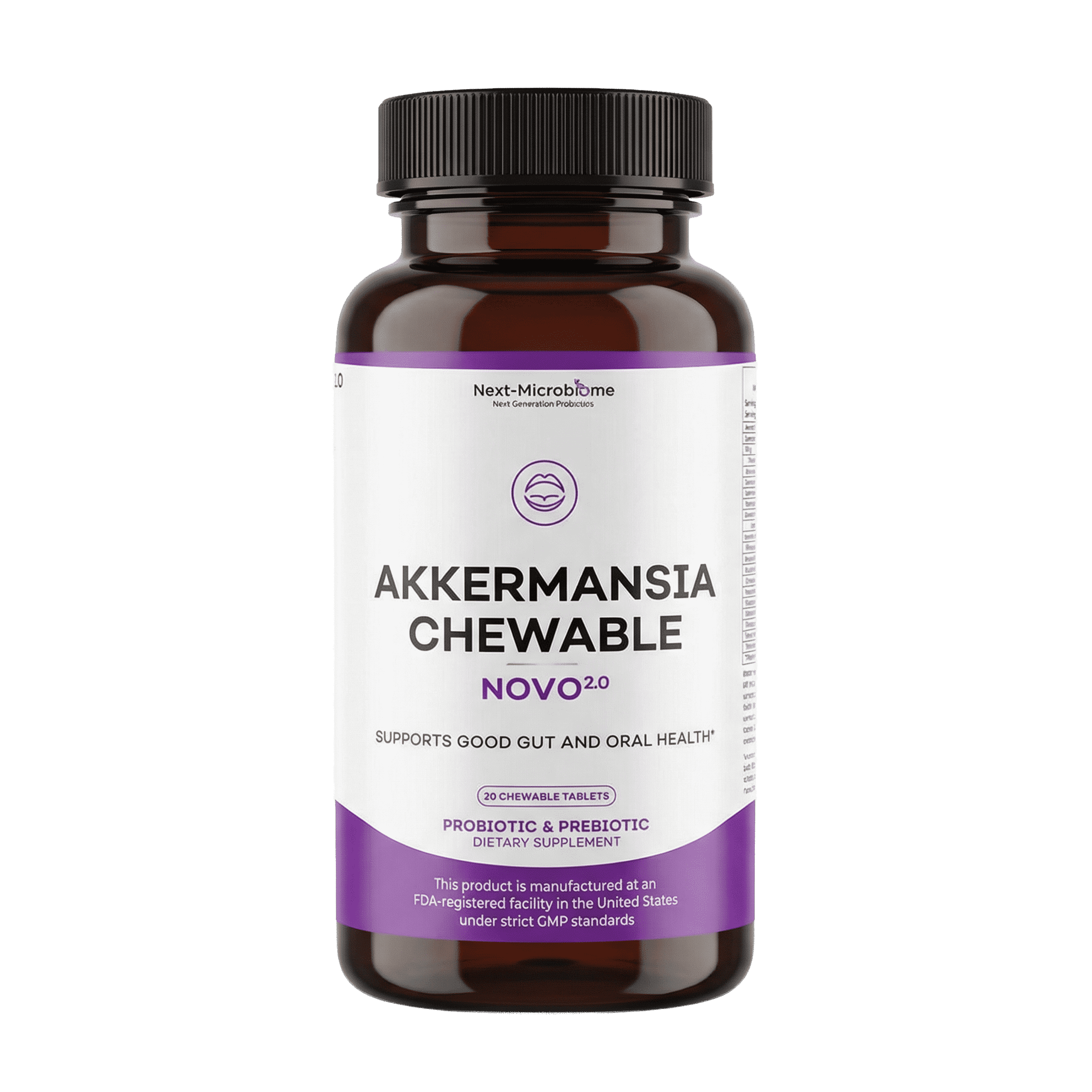
For parents familiar with the term Akkermansia probiotic, this chewable takes a different approach by using stabilized postbiotic components designed to support the gut barrier, mucosal immunity, and the child’s existing microbiota.
Next-Microbiome’s Chewable Akkermansia uses stabilized postbiotic components — not fragile live cultures — delivering bioactive molecules that directly:
-
Support the gut barrier
-
Enhance mucosal immunity
-
Promote metabolic balance
-
Complement the child’s existing microbiota
The formulation includes diverse prebiotics and botanicals that have been shown to nourish mucosal bacteria.
Scientific References
-
Xu R et al. (2023). The Role of Akkermansia muciniphila in Brain Functions.
https://pubmed.ncbi.nlm.nih.gov/35272549/
Written by Ali Rıza Akın
Microbiome Scientist, Author & Founder of Next-Microbiome
Ali Rıza Akın is a microbiome scientist with nearly 30 years of experience in translational biotechnology, systems biology, and applied microbiome research, spanning discovery, preclinical development, and clinical-stage translation.
His work focuses on how microbial ecosystems interact with human physiology, including:
-
Gut barrier function and intestinal permeability
-
Mucus-associated microbiota (Akkermansia-related systems)
-
Oral–gut microbiome axis
-
Short-chain fatty acids (SCFAs) and metabolic signaling
-
Circadian rhythm–microbiome interactions
-
Clinical Research Contributions
He has contributed to multiple clinical-stage microbiome programs, supporting bacterial strain discovery, optimization, and formulation design across different therapeutic areas, including:
Active Ulcerative Colitis (Inflammatory Bowel Disease)
Hyperoxaluria (Oxalate Metabolism Disorder)
Microbiome-driven gut health and inflammatory conditions
These studies were part of broader clinical development programs evaluating microbiome-based approaches. His contributions focused on the early-stage scientific and translational pipeline, including strain discovery, functional optimization, and multi-strain formulation design.
Scientific Contributions:
Ali Rıza Akın is the discoverer of Christensenella californii, a bacterial species associated with microbiome diversity and metabolic health.
He is a contributing author to scientific publications and Bacterial Therapy of Cancer (Springer), and the author of Bakterin Kadar Yaşa: İçimizdeki Evren: Mikrobiyotamız.
Approach:
His work emphasizes evidence-based microbiome science, long-term safety, and a systems-based understanding of how microbes influence human health.
Akkermansia and GLP-1: Natural Support for Metabolism With Food and Lifestyle
How a Healthy Microbiome May Support Kids’ Mood, Focus, and Learning
Related Posts

Why Do You Wake Up at 3 A.M.? Gut, Cortisol, Blood Sugar, and Sleep Recovery

Can Gut Health Affect Sleep? How the Microbiome May Shape Rest and Recovery

Ozempic Plateau? What Your Gut Microbiome May Be Telling You About Slower Weight Loss

Akkermansia vs Ozempic: How Gut Microbiome Support May Influence GLP-1 and Digestion

GLP-1 Side Effects: How to Ease Bloating, Constipation, and Gut Issues Naturally

Best Probiotic for Leaky Gut? Why Gut Barrier Support Differs From Digestive Probiotics

Can You Support Akkermansia Naturally, or Are Supplements Needed?
