


Chewable Probiotics vs Capsules: Why Delivery Format Matters for the Oral-Gut Axis
Chewable Probiotics vs Capsules: Why Delivery Format Matters for the Oral–Gut Microbiome Axis
Most probiotic products focus on one goal:
Getting bacteria safely to the gut.
But this overlooks a foundational insight from modern microbiome science:
What happens in the mouth determines what happens in the gut.
Chewable probiotics interact with the oral microbiome, salivary enzymes, taste receptors, vagal pathways, and upper-GI mucosa, activating biological signaling cascades that swallowed capsules completely bypass.
As demonstrated in Journal of Oral Biosciences (Wade, 2013), the oral microbiome is not passive. This is one reason oral microbiome gut health is increasingly viewed as a connected biological system in which signals from the mouth help shape digestion, inflammation, and downstream microbial behavior.
This is Blog 3 in the Oral–Gut Microbiome Cluster.
If you missed the previous article, read:
"The Oral–Gut Axis: How the Mouth Shapes Digestion, Immunity & Inflammation"
Key Takeaways
-
Delivery format changes biology, not just convenience
-
Chewables engage oral–gut signaling pathways, while capsules skip
-
Early metabolic and immune activation begins in the mouth
-
Chewables better support mucosal-dependent microbes like Akkermansia
Oral bacteria influence gut microbes, inflammation, barrier integrity, taste-receptor signaling, and even circadian metabolic timing. For the complete scientific overview, visit the Oral–Gut Microbiome Hub.
Frequently Asked Questions About Chewable Probiotics vs Capsules
A. Core Concept — How Delivery Format Changes Biology
1. Why does probiotic delivery format matter?
Because the mouth is the first immune and metabolic checkpoint of digestion, and different formats either engage or bypass this biology.
2. Do probiotic capsules interact with the oral microbiome?
No. Capsules bypass oral receptors, salivary enzymes, and mucosal immune tissue entirely.
3. What makes chewable probiotics biologically different?
Chewables dissolve in the mouth, allowing interaction with oral microbes, enzymes, immune cells, and sensory pathways before swallowing.
B. Mechanism & Biology — Oral–Gut Signaling
4. Do chewable probiotics influence GLP-1 or metabolic signaling?
Yes. Oral nutrient sensing and early mucosal signaling may influence GLP-1 and microbiome signaling, especially through taste-receptor activation, vagal pathways, and upstream enteroendocrine responses before swallowing (Gastroenterology — Liddle, 2019).
5. Can chewables activate the oral–gut axis?
Yes. Chewables engage upstream microbial and immune signaling that shapes downstream gut function.
6. Do chewables interact with mucosal immunity?
Yes. They contact oral mucosa and MALT tissue, influencing IgA secretion and immune tone.
7. Can chewables support nitric-oxide pathways?
Yes. Oral nitrate-reducing bacteria participate in vascular, metabolic, and immune signaling.
C. Symptoms, Tolerance & Use-Cases
8. Do chewable probiotics help with bloating?
They may help by improving early digestive signaling and vagal activation.
9. Are chewables better for sensitive digestion?
Often yes, because they reduce downstream digestive burden.
10. Are chewables useful for people with low stomach acid?
Yes. They begin working before stomach conditions become relevant.
11. Can chewables help with cravings or appetite control?
Early GLP-1 and vagal signaling may influence appetite regulation.
12. Are chewables helpful for stress-related gut issues?
They may support calming vagal pathways involved in digestion.
D. Comparison & Decision-Oriented Questions
13. Do chewable probiotics reach the gut alive?
Yes. Salivary mucins can enhance bacterial survival by buffering gastric acidity.
14. Do capsules bypass necessary digestive steps?
Yes. Capsules skip oral enzyme activation and immune priming.
15. Which format better supports Akkermansia biology?
Chewables support upstream mucosal conditions favorable to Akkermansia muciniphila.
16. Do chewables pair well with polyphenol-rich diets?
Yes. Polyphenols synergize with oral microbial metabolism.
17. Are chewables better tolerated by children or older adults?
Often yes, due to gentler digestion and easier administration.
18. Can chewables influence SCFA production indirectly?
Yes. Early digestion and mucosal signaling shape downstream fermentation.
19. Do chewables support circadian digestion rhythms?
Upper-GI signaling contributes to metabolic timing.
20. Which chewable aligns best with oral–gut biology?
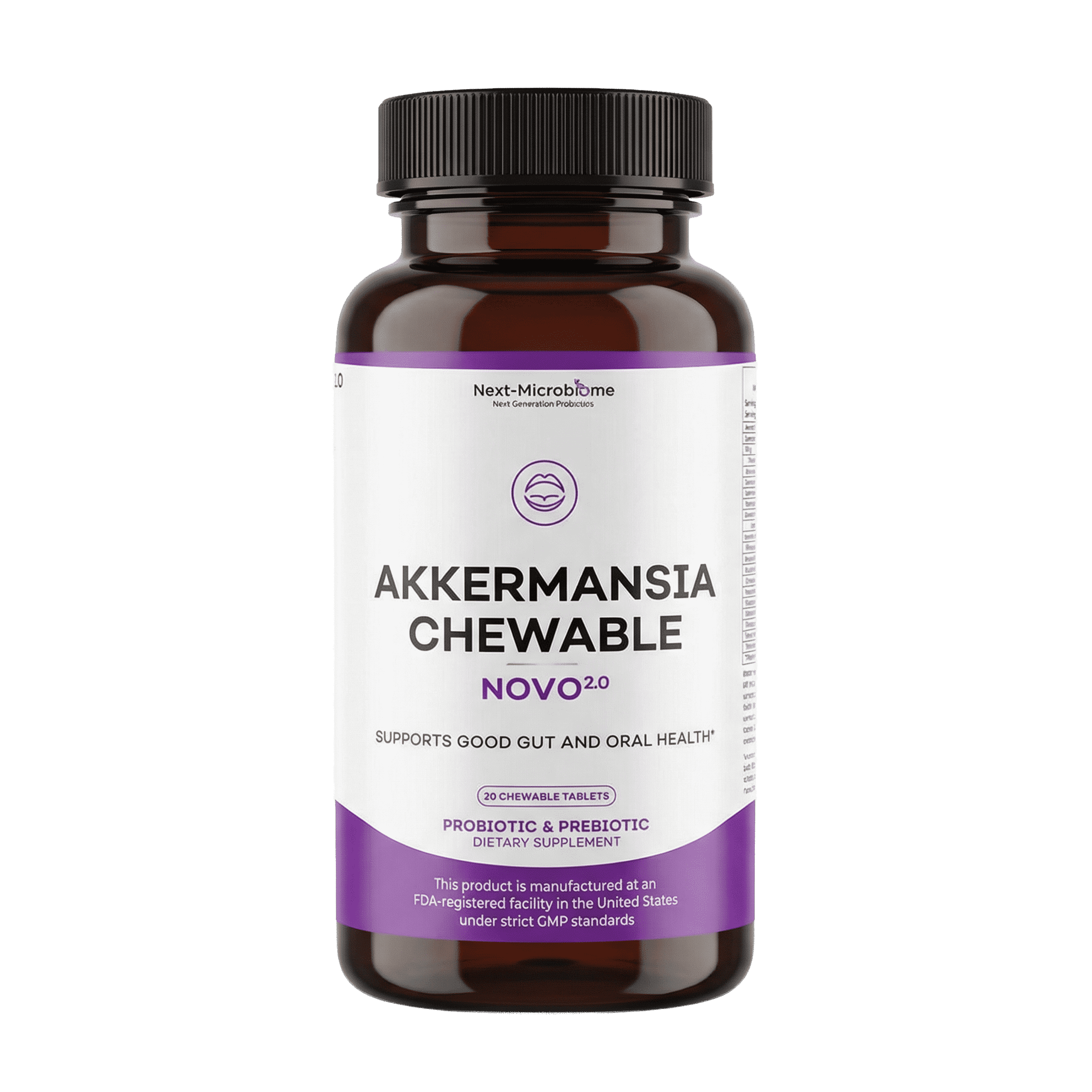
Akkermansia Chewable — Probiome NOVO 2.0.
1. Why the Mouth Is the First Microbiome Target
Chewable probiotics begin working before they are swallowed, making them biologically distinct from capsules.
The oral cavity contains:
-
a dense microbial ecosystem
-
mucosal immune tissue (MALT)
-
nitrate-reducing bacteria
-
enteroendocrine precursor signaling
-
sweet, fat, and amino-acid taste receptors
-
vagus-nerve terminals
As described in Journal of Oral Biosciences (Wade, 2013), these systems regulate early digestion, immune tone, and metabolic signaling.
Capsules bypass all of this, entering the stomach without activating upstream biology.

2. Salivary Enzymes + Chewables = Early Biological Activation
Saliva contains amylase, lipase, mucins, antimicrobial peptides, IgA, and nitrate-reducing bacteria.
These components directly interact with chewable probiotics.
A landmark eLife study (Schmidt T.S.B., 2019) demonstrated that oral microbes and salivary interactions shape downstream gastrointestinal microbial structure and immune tone.
Capsules dissolve after this signaling window has closed.
3. Oral Nutrient Sensing → GLP-1 → Appetite Regulation
Oral nutrient sensing initiates endocrine signaling before swallowing, which is one reason GLP-1 microbiome science has become an important area of interest in metabolic and digestive research.
According to Gastroenterology (Liddle, 2019), upstream activation includes:
-
taste-receptor engagement
-
vagal-nerve signaling
-
cephalic-phase insulin release
-
early GLP-1 secretion
Chewables stimulate these pathways. Capsules do not.
For metabolic integration, see:
How GLP-1 and the Gut Microbiome Support Metabolism and Weight Management
4. Oral–Gut Immune Signaling and MALT Activation
Oral tissues are part of the mucosa-associated lymphoid tissue (MALT) system.
As detailed in Microorganisms (Willis & Gabaldón, 2020), oral immune signaling influences IgA secretion, immune tolerance, and downstream gut barrier and intestinal lining health.
Chewables engage this system directly.
5. Why Chewables Support Akkermansia Biology
Akkermansia muciniphila science increasingly focuses on how this bacterium relates to mucosal integrity, mucin dynamics, SCFA networks, and immune signaling. These are the same upstream conditions chewable delivery formats are designed to engage.
Chewables influence upper-GI and mucosal environments, supporting conditions favorable for Akkermansia.

REFERENCES
-
Wade WG. (2013). The oral microbiome in health and disease. Journal of Oral Biosciences.
-
Schmidt T.S.B. et al. (2019). Drivers and determinants of the human gut microbiome. eLife.
-
Willis J.R., Gabaldón T. (2020). The human oral microbiome in health and disease. Microorganisms.
Written by Ali Rıza Akın
Microbiome Scientist, Author & Founder of Next-Microbiome
Ali Rıza Akın is a microbiome scientist with nearly three decades of experience in translational biotechnology and microbiome research, spanning academic discovery, wet-lab experimentation, systems biology, and commercial product development in Silicon Valley.
His scientific work focuses on host–microbe interactions and the biological interfaces where microbial ecosystems directly influence human physiology. Core areas of expertise include oral–gut microbiome communication, mucosal barrier biology, immune–metabolic signaling, short-chain fatty acid (SCFA) metabolism, GLP-1–related enteroendocrine pathways, and circadian–microbiome interactions.
Ali Rıza Akın is the discoverer of Christensenella californii, a human-associated bacterial species linked in the scientific literature to mucosal integrity, metabolic regulation, and immune homeostasis.
He has contributed to peer-reviewed scientific literature and major academic volumes, including Bacterial Therapy of Cancer (Springer), and is the author of Bakterin Kadar Yaşa: İçimizdeki Evren (“Live As Long As Your Bacteria”).
As the Founder of Next-Microbiome, he leads the development of next-generation synbiotic formulations grounded in validated biological mechanisms rather than trend-driven claims, with a strong commitment to scientific accuracy, transparency, and responsible microbiome innovation.
How Do Mouth Microbes Affect Gut Health and Digestion?
How Prebiotics Support the Gut Microbiome, Digestion, and Overall Health
Related Posts

Akkermansia vs Ozempic: How Gut Microbiome Support May Influence GLP-1 and Digestion

GLP-1 Side Effects? Fix Bloating & Constipation Fast (Gut-Science Guide)

Which Probiotics May Help Support Leaky Gut and the Gut Barrier?

Can You Support Akkermansia Naturally, or Are Supplements Needed?

GLP-1 Causing Bloating or Constipation? Here’s Why Gut Microbiome Balance May Matter

What Does Science Say About Akkermansia for Gut Health?

7 Akkermansia Benefits for Gut Health, Weight, Metabolism, and Microbiome Balance
