


What Is Akkermansia and How Does It Support Gut Health and Metabolism?
Unlocking the Unknown Secrets of Akkermansia muciniphila: Your Beneficial Gut Guardian
Akkermansia muciniphila science has drawn increasing attention for its potential role in gut barrier function, metabolic health, and host-microbiome interactions.
First isolated by microbiologist Muriel Derrien in 2004, Akkermansia resides within the gut's mucus layer, influencing gut integrity, metabolic health, and overall wellness (Derrien et al., 2004).
What is Akkermansia muciniphila?
Akkermansia muciniphila is a probiotic bacterium that plays a crucial role in maintaining gut health. By thriving on mucins—special proteins in gut mucus—it strengthens the intestinal barrier, helping prevent diseases and promoting overall health.
Benefits of Akkermansia muciniphila
1. Enhancing Gut Barrier Function
A robust gut barrier protects against pathogens and toxins. Akkermansia supports gut barrier and intestinal lining health by promoting mucus production and integrity, which are crucial for gut health (Everard et al., 2013).
This is one reason readers exploring broader topics such as leaky gut and microbiome support often encounter Akkermansia in discussions of mucus integrity, microbial balance, and barrier resilience.
For readers comparing options, the best probiotic for gut lining is usually one that supports mucus integrity, microbial balance, and barrier resilience rather than focusing on a single short-term claim.
2. Reducing Chronic Inflammation
Chronic inflammation is linked to obesity, diabetes, and autoimmune conditions. Akkermansia reduces inflammation through the production of anti-inflammatory molecules and short-chain fatty acids (SCFAs) like butyrate (Ottman et al., 2017).
3. Supporting Weight Loss and Metabolism
Studies confirm that higher Akkermansia levels correlate with reduced fat mass, improved insulin sensitivity, and lower cholesterol levels, thus aiding effective weight management (Depommier et al., 2019).
For readers exploring targeted options, a metabolic support probiotic is best understood as part of a broader strategy that includes gut barrier support, microbial balance, and diet quality rather than as a stand-alone solution.
4. Improving Blood Sugar Control
Akkermansia enhances glucose metabolism, improving insulin sensitivity and promoting effective glucose utilization, beneficial for diabetes management (Plovier et al., 2017).
5. Boosting Mental Health
Akkermansia supports mental health via the gut-brain axis, reducing inflammation, enhancing gut integrity, and positively influencing mood and cognition, potentially reducing anxiety and depression (Cryan et al., 2019).
6. Combatting Aging
Research indicates Akkermansia supplementation can delay age-related declines, enhancing cognitive function, mobility, and metabolic health, suggesting its role as an anti-aging probiotic (van der Lugt et al., 2019).
7. Strengthening Immune Function
By balancing gut microbiota, Akkermansia enhances immune responses, protecting against infections and autoimmune diseases (Belkaid & Hand, 2014).
8. Natural Detoxification
Akkermansia promotes mucus production and gut cell renewal, supporting the body’s detoxification processes and reducing toxin accumulation (Everard et al., 2013).
9. Potential Cancer Prevention
Emerging research indicates Akkermansia could protect against colorectal cancer by maintaining gut integrity, reducing inflammation, and fostering microbial balance (Routy et al., 2018).
10. Promoting Oral Health
Akkermansia positively influences oral microbiota, reducing inflammation and improving overall oral health, which also reflects growing interest in the oral–gut axis and longevity as part of broader host-microbiome research (Zaura et al., 2009).
Increasing Akkermansia Levels Naturally
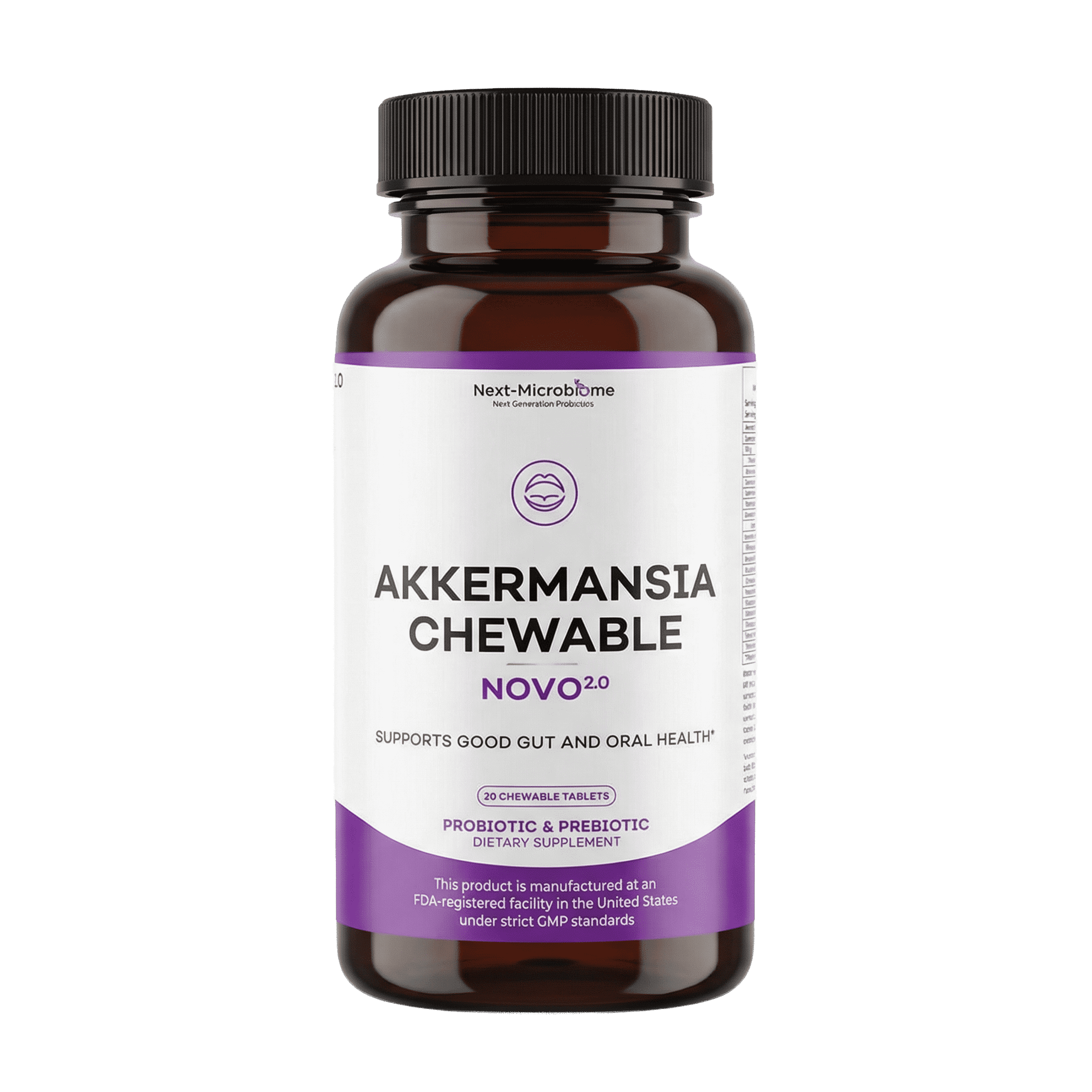
Akkermansia muciniphila supplements, especially chewable tablets optimize gut colonization and efficacy. Dietary strategies to boost Akkermansia naturally include regular intake of fibers, polyphenols, and prebiotics.
Polyphenols, Cross-Feeding & GLP-1
Polyphenol-rich compounds found in cranberries, pomegranate, and green tea have been shown to promote Akkermansia abundance in both animal and human models. These compounds act as selective microbial modulators rather than simple antioxidants.
When individuals attempt to increase akkermansia naturally, the mechanism often involves microbial cross-feeding: fibers are fermented into SCFAs, which improve epithelial integrity and metabolic signaling.
This is also where GLP-1 microbiome support becomes relevant, because SCFA production helps connect microbial activity, gut barrier health, and metabolic signaling in a more integrated way.
Intermittent fasting may also stimulate mucin dynamics, indirectly influencing Akkermansia levels.
For more details on SCFAs, review our SCFA article.
Next-microbiome research continues to emphasize that strategic microbial support — not isolated intervention — drives sustainable Akkermansia balance.
Strategy Comparison
|
Approach |
Direct Effect |
Long-Term Sustainability |
|
Polyphenols |
High |
High |
|
Prebiotics |
Moderate |
High |
|
Fasting |
Indirect |
Variable |
|
Probiotics |
Supportive |
Moderate |
Scientific References
Roopchand et al., 2015
Dietary polyphenols promote growth of Akkermansia muciniphila.
Diabetes.
Anhê et al., 2015
A polyphenol-rich cranberry extract protects from diet-induced obesity via Akkermansia muciniphila increase.
Gut.
Zhang et al., 2020
Intermittent fasting reshapes the gut microbiota and promotes intestinal health.
Nutrients.
Depommier et al., 2019 (Human Trial)
Supplementation with Akkermansia muciniphila improves metabolic parameters in overweight/obese humans.
Nature Medicine.
These directly support strategies to increase akkermansia naturally.
Future Research and Potential
Research on Akkermansia muciniphila continues to expand, especially in areas such as gut barrier support, metabolic signaling, and microbiome balance, although many questions still require further human investigation.
References
-
Derrien, M., et al. (2004). International Journal of Systematic and Evolutionary Microbiology.
-
Everard, A., et al. (2013). Proceedings of the National Academy of Sciences.
-
Ottman, N., et al. (2017). Frontiers in Microbiology.
-
Depommier, C., et al. (2019). Nature Medicine.
-
Plovier, H., et al. (2017). Nature Medicine.
-
Cryan, J. F., et al. (2019). Nature Reviews Neuroscience.
-
van der Lugt, B., et al. (2019). Nature Aging.
-
Belkaid, Y., & Hand, T. (2014). Cell.
-
Routy, B., et al. (2018). Science.
-
Zaura, E., et al. (2009). Journal of Clinical Microbiology.
Conclusion
Akkermansia muciniphila is an essential probiotic bacterium with profound health benefits, from enhancing gut health and metabolism to supporting immunity and mental wellness. Its increasing recognition in scientific research highlights its promising role in future health strategies and probiotic development.
FAQ:
1. What foods help increase akkermansia naturally?
Polyphenol-rich fruits, inulin fibers, and resistant starch sources are commonly studied.
2. Does fasting increase Akkermansia?
Short-term fasting may support mucin renewal and microbial diversity.
3. Are probiotics effective?
Some strains provide indirect support, especially those linked to clostridium butyricum benefits.
Written by Ali Rıza Akın
Microbiome Scientist, Author & Founder of Next-Microbiome
Ali Rıza Akın is a microbiome scientist with nearly 30 years of experience in translational biotechnology, systems biology, and applied microbiome research, spanning discovery, preclinical development, and clinical-stage translation.
His work focuses on how microbial ecosystems interact with human physiology, including:
-
Gut barrier function and intestinal permeability
-
Mucus-associated microbiota (Akkermansia-related systems)
-
Oral–gut microbiome axis
-
Short-chain fatty acids (SCFAs) and metabolic signaling
-
Circadian rhythm–microbiome interactions
-
Clinical Research Contributions
He has contributed to multiple clinical-stage microbiome programs, supporting bacterial strain discovery, optimization, and formulation design across different therapeutic areas, including:
Active Ulcerative Colitis (Inflammatory Bowel Disease)
Hyperoxaluria (Oxalate Metabolism Disorder)
Microbiome-driven gut health and inflammatory conditions
These studies were part of broader clinical development programs evaluating microbiome-based approaches. His contributions focused on the early-stage scientific and translational pipeline, including strain discovery, functional optimization, and multi-strain formulation design.
Scientific Contributions:
Ali Rıza Akın is the discoverer of Christensenella californii, a bacterial species associated with microbiome diversity and metabolic health.
He is a contributing author to scientific publications and Bacterial Therapy of Cancer (Springer), and the author of Bakterin Kadar Yaşa: İçimizdeki Evren: Mikrobiyotamız.
Approach:
His work emphasizes evidence-based microbiome science, long-term safety, and a systems-based understanding of how microbes influence human health.
Are Chewable Probiotics Better Than Capsules for Gut Health and the Oral-Gut Axis?
Can Akkermansia Support Healthy Gut Microbiome Development in Kids?
Related Posts

Ozempic Plateau? What Your Gut Microbiome May Be Telling You About Slower Weight Loss

Akkermansia vs Ozempic: How Gut Microbiome Support May Influence GLP-1 and Digestion

GLP-1 Side Effects: How to Ease Bloating, Constipation, and Gut Issues Naturally

Best Probiotic for Leaky Gut? Why Gut Barrier Support Differs From Digestive Probiotics

Can You Support Akkermansia Naturally, or Are Supplements Needed?

GLP-1 Not Working? How Your Gut Microbiome May Be Affecting GLP-1 Signaling

What Does Science Say About Akkermansia for Gut Health?
