


Gut Microbial Clock: How Gut Bacteria Shape Sleep, Cravings, and Circadian Timing
The Microbiome’s 24-Hour Clock: How Gut Bacteria Control Your Sleep Cycle
How the microbiome shapes circadian rhythm, metabolic timing, hunger, sleep depth, and morning energy.
Introduction — Your Body Has Two Clocks, Not One
Most people think sleep is controlled only by the brain.
But inside your gut, billions of microbes also follow a 24-hour rhythm.
They wake, feed, rest, and signal in metabolic cycles — releasing molecules that synchronize:
-
sleep drive
-
hunger and satiety hormones
-
GLP-1 secretion
-
cortisol rhythm
-
gut-barrier repair
-
inflammation dynamics
-
metabolic timing
These daily microbial cycles are one reason GLP-1 microbiome science is increasingly relevant to circadian biology, since microbial timing helps shape appetite, satiety, and metabolic regulation across the 24-hour cycle.
This internal timing network is often referred to as the Gut Microbial Clock. It coordinates microbial activity with hormonal signaling, immune tone, and metabolic rhythms across the 24-hour cycle.
When this system becomes destabilized, sleep architecture may become lighter or fragmented, morning energy can decline, cravings may increase, cortisol regulation can become erratic, and metabolic resilience may weaken.
Understanding this microbial timing system is essential to explaining why modern patterns of insomnia, late-night hunger, and circadian misalignment are increasingly common. A gut-brain sleep formula is designed to support this interconnected network by reinforcing circadian and microbial alignment rather than overriding it.
If you're following this blog cluster, you’ve already read:
Circadian Rhythm & Gut Microbiome: Sleep and Energy Guide
Gut–Brain–Sleep Axis: Microbes, Melatonin & Cortisol
This final article reveals how microbes keep time — and why your internal clock depends on theirs.
FREQUENTLY ASKED QUESTIONS ABOUT THE GUT MICROBIAL CLOCK:
1. Can gut bacteria really control my sleep cycle?
Yes. Gut microbes release metabolites such as SCFAs that influence melatonin synthesis, GLP-1 timing, cortisol rhythm, vagal signaling, and nighttime inflammation — all of which regulate sleep depth. (Thaiss et al., 2016)
2. What is the “gut microbial clock”?
It is the 24-hour rhythm of microbial metabolism and gene expression that coordinates sleep, appetite, gut repair, and metabolic timing.
3. How does the microbiome communicate with the brain during sleep?
Through SCFAs, serotonin/melatonin precursors, vagal signaling, immune pathways, and inflammation-modulating metabolites.
4. What happens when the gut clock is disrupted?
Common symptoms include light sleep, frequent waking, cravings, morning fatigue, mood instability, cortisol spikes, poor glucose control, and metabolic slowdown.
5. Does circadian rhythm affect the microbiome too?
Yes — poor sleep, shift work, and irregular eating collapse microbial oscillations, further disrupting the biological clock.
6. Can restoring microbial balance improve sleep quality?
Yes. SCFA producers and mucin-supporting bacteria (such as Akkermansia) stabilize nighttime rhythms and deepen sleep.
7. How does Akkermansia muciniphila affect circadian rhythm?
Akkermansia supports gut barrier and intestinal lining health, enhances GLP-1 sensitivity, reduces inflammation, and helps coordinate nighttime mucosal repair. (Everard et al., 2013)
8. What foods support the microbial clock?
Fiber-rich vegetables, resistant starch, polyphenols, fermented foods, and prebiotics that boost SCFA production.
9. Does stress affect microbial rhythms?
Yes. Cortisol disrupts microbial oscillation, decreases SCFA production, damages the mucosal layer, and destabilizes sleep.
10. How does late-night eating damage the gut clock?
It forces microbes into daytime metabolic programs at night, preventing repair and increasing inflammation.
11. Can probiotics fix a broken sleep cycle?
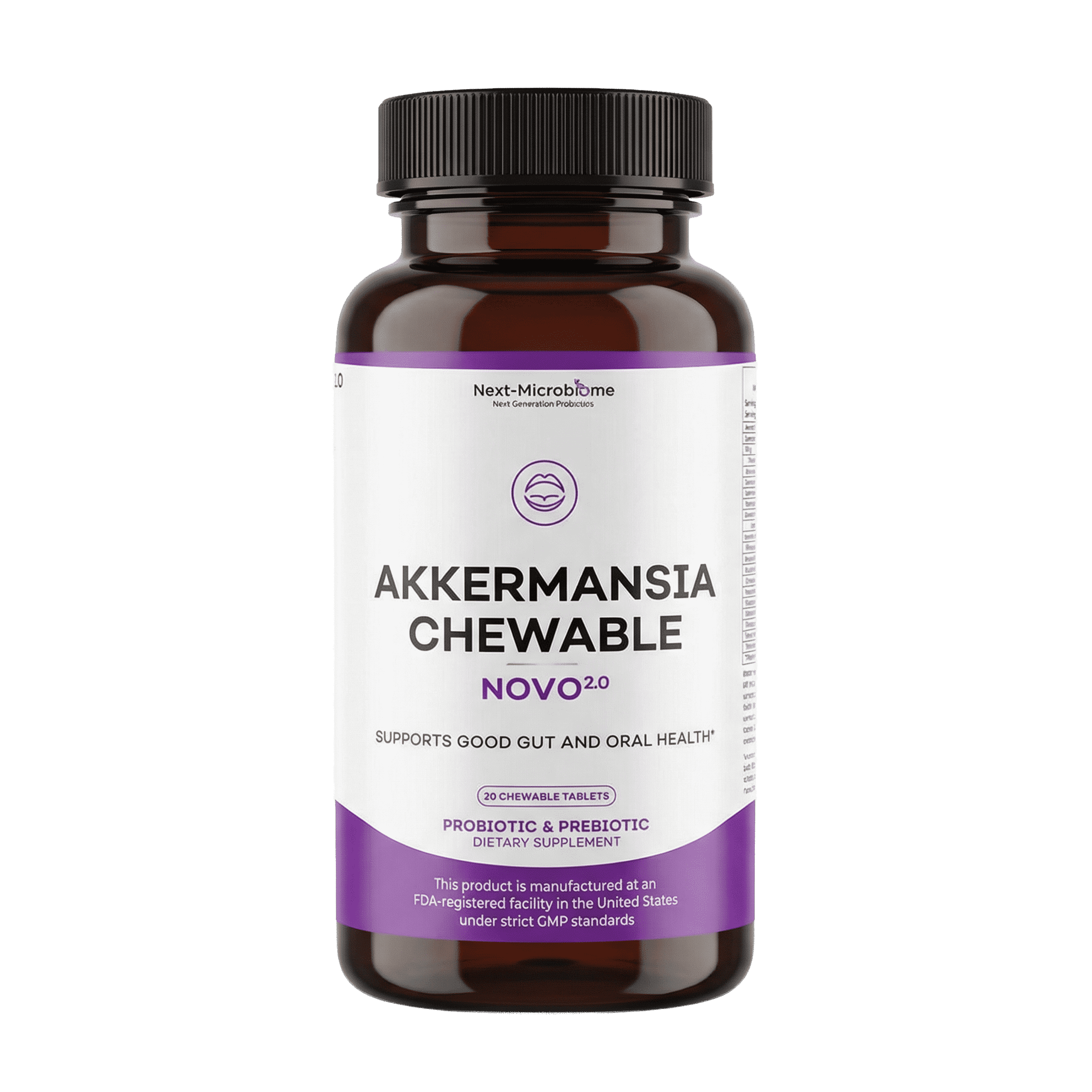
Only if they restore mucosal integrity and SCFA output. This is why Akkermansia Chewable uniquely impacts sleep: it works in the mouth and gut.
12. What is the fastest way to reset the gut microbial clock?
Re-synchronizing the microbial clock requires reinforcing external time cues, including consistent sleep–wake cycles, morning light exposure, time-restricted feeding (12–14 hours), fiber diversity, targeted Akkermansia support, and reduced nocturnal eating. Microbiome-based sleep support strategies are designed to work alongside these circadian inputs.
13. Is the oral microbiome part of the gut clock?
Indirectly, yes. Oral bacteria seed the gut with every swallow. Oral dysbiosis disrupts downstream microbial rhythms. (Schmidt et al., 2019)
14. Why do cravings increase at night when the gut clock is disrupted?
Low SCFAs + low GLP-1 + high cortisol = powerful biological cravings.
15. Is the microbial clock important for weight loss?
Very. GLP-1 rhythm, gut-barrier repair, SCFA levels, and insulin sensitivity are all circadian processes.
16. Do gut bacteria influence sleep quality?
Microbial metabolites interact with the nervous system and circadian regulation.
17. How can gut health support sleep?
Diet, circadian alignment, and microbiome diversity support healthy microbial rhythms.
References
-
Leone V et al., Cell Host & Microbe, 2015
If your goal is gut-lining strength, inflammation control, or metabolic resilience, Akkermansia is the bacteria to understand first. Explore our full Akkermansia Microbiome Guide.
1. Gut Bacteria Follow a 24-Hour Circadian Cycle
Your gut microbiome is not static.
It moves, grows, and secretes metabolites on a predictable schedule.
Microbes follow daily oscillations:
• Some species peak during the day
• Others peak at night
• SCFA (short-chain fatty acid) levels rise and fall hourly
• Metabolism shifts with feeding and fasting
Scientific Reference #1 — Microbial Circadian Rhythm (Cell Host & Microbe)
This foundational work showed that microbes anticipate feeding times and help regulate metabolic and hormonal timing.
Microbes follow your clock.
Your clock follows your microbes.
It is a two-way timekeeping system.
2. Feeding Windows Reset Microbial Clocks
Your microbiome depends on predictable timing:
• when you first eat
• how long your feeding window lasts
• when you stop eating
When meal timing becomes irregular, microbial timing collapses.
Late-night eating causes:
• reduced SCFA production
• inflammation in microbial communities
• delayed melatonin onset
• elevated nighttime cortisol
• fragmented sleep architecture
Stable feeding windows = stable microbial clocks.
3. SCFAs Are Nighttime Sleep Signals
Your microbes produce SCFAs on a daily rhythm.
Butyrate — the most influential — acts as a nighttime biological signal that stabilizes sleep.
SCFAs:
• deepen slow-wave sleep
• stabilize REM
• calm inflammation
• regulate melatonin production
• support a healthy cortisol cycle
• activate vagus-nerve calming pathways
Scientific Reference #3 — Butyrate Improves Sleep Quality (Scientific Reports, 2021)
Low SCFA output = lighter sleep and morning fatigue.
These same SCFA rhythms also help explain the connection between GLP-1 and microbiome signaling, since microbial metabolites influence appetite regulation and metabolic timing alongside sleep physiology.
4. Microbial Clock Disruption = Circadian Collapse
Microbial clocks can be disrupted by:
• psychological stress
• screens and blue light at night
• late-night meals
• alcohol
• antibiotics
• low-fiber diet
• jet lag
• inflammation
• oral–gut dysbiosis
The result:
• delayed sleep
• melatonin suppression
• nighttime cortisol spikes
• unstable REM and deep-sleep patterns
• difficulty waking
• mood vulnerability
Scientific Reference #4 — Gut Clock Disruption Causes Dysbiosis & Barrier Breakdown (Science Advances, 2024)
This updated paper reveals that when the intestinal circadian clock breaks down:
• microbial composition changes
• harmful bacteria expand
• beneficial species shrink
• barrier integrity weakens
• inflammation increases
This is one of the strongest demonstrations to date that disruption of the microbial clock directly drives intestinal dysfunction — proving that circadian timing is a structural requirement for gut health.
If microbial clocks fall apart, your human circadian rhythm cannot remain stable.
5. Oral–Gut Timing Signals: The Missing Layer
Circadian timing does not start in the gut.
It begins in the mouth.
Oral microbes influence:
• cortisol patterning
• systemic inflammation
• vagus nerve tone
• downstream gut microbial structure
Chewable microbiome formulations activate earlier along the GI tract and help restore this top-down timing sequence.
6. How to Restore Your Microbial Clock
These science-backed strategies realign microbial timekeeping:
1. Keep a consistent feeding window (10–12 hours)
Predictable timing stabilizes microbial oscillation.
2. Get morning sunlight
The strongest circadian-reset signal for the entire body.
3. Reduce blue light at night
Protects melatonin and microbial nighttime behavior.
4. Increase fiber + resistant starch
Feeds SCFA-producing bacteria that reinforce circadian timing.
5. Add polyphenols
Berries, pomegranate, cocoa, and green tea support beneficial microbial oscillation.
6. Support SCFA-producing strains
Including Clostridium butyricum for butyrate.
7. Use chewable microbiome formulas
For oral–gut synchronization and earlier circadian signaling.
Microbiome-Based Sleep Support (Melatonin-Free)
Melatonin does not repair your circadian rhythm — it overrides it.
Microbiome-based solutions restore the system from the source.
Supporting microbial timing improves:
• SCFA (butyrate) deep-sleep pathways
• morning cortisol peak
• melatonin rhythm
• vagus nerve calm
• inflammation control
• microbial day–night oscillation
Sleepy-Biome — Melatonin-Free Sleep Support

INTERNAL LINKS
Foundational Circadian Guide
Microbes, Melatonin, and Cortisol
Written by Ali Rıza Akın
Microbiome Scientist • Author • Founder of Next-Microbiome California Inc.
Ali Rıza Akın is a microbiome scientist with nearly 30 years of experience in biotechnology and translational research in Silicon Valley. His work focuses on gut microbiota, mucosal barrier biology, SCFA metabolism, circadian rhythm, GLP-1 physiology, and host–microbe metabolic signaling.
He is the discoverer of Christensenella californii, a human-associated microbial species linked to mucosal integrity, metabolic resilience, immune balance, and microbial ecology.
His scientific and translational expertise includes:
-
GLP-1 and enteroendocrine signaling
-
SCFA-mediated metabolic pathways
-
Circadian rhythm and gut microbial timing
-
Mucosal barrier restoration and gut immunology
-
HPA axis, cortisol physiology, and stress biology
-
Oral–gut microbial ecology and colonization resistance
-
Development of next-generation synbiotics
-
Clinical translation of microbiome science for metabolic and immune health
Ali Rıza Akın is the author of Bakterin Kadar Yaşa: İçimizdeki Evren, a comprehensive science-based work on human microbiota, and a contributing author to Bacterial Therapy of Cancer (Springer).
As the Founder of Next-Microbiome California Inc., he leads research and development of Akkermansia-based formulations, mucosal-targeted probiotics, SCFA-supporting synbiotics, and oral–gut–brain axis innovations designed to strengthen metabolic stability, improve gut barrier function, and support long-term health.
His scientific mission is to translate advanced microbiome biology into accessible, evidence-based solutions that improve human resilience, metabolic health, and longevity.
Your Gut May Be Ruining Your Sleep: Why Your Microbiome May Be Disrupting Deep Sleep
How Can Gut Microbes Help Restore Natural Sleep Rhythm?
Related Posts

Ozempic Plateau? What Your Gut Microbiome May Be Telling You About Slower Weight Loss

Akkermansia vs Ozempic: How Gut Microbiome Support May Influence GLP-1 and Digestion

GLP-1 Side Effects: How to Ease Bloating, Constipation, and Gut Issues Naturally

Best Probiotic for Leaky Gut? Why Gut Barrier Support Differs From Digestive Probiotics

Can You Support Akkermansia Naturally, or Are Supplements Needed?

GLP-1 Not Working? How Your Gut Microbiome May Be Affecting GLP-1 Signaling

What Does Science Say About Akkermansia for Gut Health?
