


Intestinal Permeability vs Leaky Gut: What Science Actually Says About Gut Barrier Regulation
Intestinal Permeability vs. Leaky Gut: What Science Actually Says
The terms “intestinal permeability” and “leaky gut” are often used interchangeably — but they do not mean the same thing.
In scientific research, intestinal permeability is a measurable physiological phenomenon. Leaky gut, on the other hand, is a functional, non-clinical term commonly used to describe patterns associated with increased gut barrier permeability.
Understanding this distinction is essential for separating evidence-based biology from oversimplified or misleading claims.
Key Takeaways
-
Intestinal permeability is a regulated biological process studied in gastroenterology and immunology
-
Leaky gut is a non-clinical term describing patterns linked to increased permeability
-
The gut barrier is influenced by tight junctions, the mucus layer, microbes, and microbial metabolites
-
Short-chain fatty acids (SCFAs) play a central role in barrier regulation
-
Increased permeability is context-dependent and not always harmful
-
Long-term gut barrier support focuses on regulation and resilience, not “sealing” the gut
Why This Distinction Matters
Confusing these terms can lead to:
-
Fear-based health messaging
-
Overdiagnosis
-
Unsubstantiated treatment claims
Science does not recognize leaky gut as a standalone disease. What it does recognize is that intestinal permeability is dynamically regulated and can increase under specific biological conditions.
For readers exploring intestinal permeability science, this distinction matters because research focuses on measurable barrier regulation, not broad or fear-based claims about “leaky gut.”
To understand this properly, it helps to begin with the structural foundation of the gut barrier:
"Gut Barrier Health: Science of Intestinal Integrity"
What Is Intestinal Permeability (Scientifically)?
The intestinal barrier is a living interface composed of:
-
A single layer of epithelial cells
-
Tight junction proteins regulating passage between cells
-
A protective mucus layer
-
A diverse microbial ecosystem supporting mucosal integrity
When functioning correctly, this system allows nutrients to be absorbed while preventing bacteria, toxins, and inflammatory molecules from entering circulation.
This is why intestinal integrity is best understood as a regulated system involving epithelial cells, tight junctions, mucus protection, immune signaling, and microbial balance.
Research shows that tight junction proteins are dynamic regulators, not static seals. Mechanistic reviews by Chelakkot et al., published in Experimental & Molecular Medicine (2018), describe how dysregulation of these junctions is associated with increased intestinal permeability and immune activation.

What Does “Leaky Gut” Actually Refer To?
“Leaky gut” is a non-clinical umbrella term often used to describe situations where intestinal permeability increases beyond its healthy regulatory range.
It is commonly associated with patterns such as:
-
Digestive discomfort
-
Immune activation
-
Systemic inflammation
-
Metabolic imbalance
For a deeper exploration of symptoms, causes, and repair pathways often discussed in this context, see:
"Leaky Gut Syndrome: Symptoms, Causes & Gut Repair"
The Broader Microbiome Context
Intestinal permeability is best understood within the broader context of the human microbiome, where microbial communities, epithelial cells, immune signaling, and microbial metabolites function as an integrated biological system rather than isolated components.
Disruptions in this ecosystem can influence how tightly the intestinal barrier is regulated over time.
Readers who want a wider overview can use this gut health microbiome guide to understand how microbes, diet, barrier function, inflammation, and digestive resilience work together.
What Science Confirms (and What It Doesn’t)
What Science Confirms
-
Intestinal permeability is measurable
-
Tight junctions are dynamically regulated
-
Permeability increases under specific conditions (stress, inflammation, dysbiosis)
-
Barrier integrity influences immune and metabolic signaling
This is also where SCFAs and metabolic health become relevant, since short-chain fatty acids help connect microbial activity with inflammation regulation, epithelial energy use, and metabolic communication.
In that context, a metabolic support probiotic is best understood as a microbiome-supportive option that may complement barrier regulation and microbial metabolite pathways, not as a stand-alone solution for intestinal permeability.
What Science Does Not Support
-
Leaky gut as a single diagnostic disease
-
One-size-fits-all treatment protocols
-
Claims that all chronic illness originates from leaky gut
For readers researching an Akkermansia muciniphila supplement, the most important starting point is understanding the biology behind gut barrier regulation. Akkermansia is most relevant to mucus-layer support, epithelial signaling, microbial balance, and long-term barrier resilience rather than as a quick solution for “leaky gut.”

Key Biological Mechanisms That Influence Permeability
1. Tight Junction Regulation
Tight junction proteins respond to inflammatory signals, microbial metabolites, and circadian cues. Their regulation determines whether permeability remains controlled or becomes excessive.
2. The Mucus Layer
The mucus layer acts as a physical and immunological buffer. Disruption of mucus integrity may expose epithelial cells to microbial contact.
Research by Plovier et al., published in Nature Medicine (2017), showed that Akkermansia muciniphila and its membrane components influence mucus layer thickness and epithelial signaling, highlighting the importance of mucus-associated microbes in barrier regulation.
This is one reason research into Akkermansia muciniphila benefits continues to draw attention in gut barrier science, particularly in relation to mucus-layer support, epithelial signaling, and microbiome balance.

3. Microbial Metabolites (SCFAs)
Short-chain fatty acids (SCFAs), produced during fiber fermentation, play a direct role in:
-
Epithelial energy metabolism
-
Tight junction reinforcement
-
Anti-inflammatory signaling
Seminal work by Koh et al., published in Cell (2016) demonstrated how SCFAs support epithelial integrity and immune balance.
 Why Increased Permeability Is Context-Dependent
Not all increases in permeability are harmful.
Temporary changes may occur:
-
During intense physical exertion
-
During immune activation
-
As part of normal gut–immune communication
An expert consensus paper by Bischoff et al., published in BMC Gastroenterology (2014), emphasized that intestinal permeability should be viewed as a functional biological state rather than a disease entity.
Problems arise when regulation becomes chronically disrupted, rather than transiently adjusted.
Frequently Asked Questions About Intestinal Permeability and Leaky Gut:
1. Are probiotics helpful for leaky gut?
Some microbiome-focused formulations are studied for supporting mucus layer health and microbial balance, depending on the biological context.
Neutral mechanism-based integration:
Some mechanism-driven microbiome formulations focus on supporting mucus-associated microbes and SCFA-producing pathways, which research suggests may contribute to gut barrier regulation when used as part of a broader dietary and lifestyle approach.
In this context, akkermansia gut health research is relevant because Akkermansia is commonly studied for its relationship with the mucus layer, epithelial signaling, and microbial balance.
For readers comparing options, the best probiotic for gut lining is usually one that supports mucus-associated microbes, SCFA production, and long-term barrier regulation rather than promising to “seal” the gut quickly.
2. How do doctors test intestinal permeability?
There is no single standard medical test that diagnoses “leaky gut” as a disease. In research and some specialty settings, intestinal permeability can be assessed with methods such as orally ingested sugar probes like lactulose and mannitol, while some endoscopic or biopsy-based techniques are used more selectively. Consumer blood or stool kits marketed for “leaky gut,” especially zonulin-based tests, are not considered well validated for diagnosing it.
Medical Reference:
https://my.clevelandclinic.org/health/diseases/22724-leaky-gut-syndrome
Scientific References:
https://pubmed.ncbi.nlm.nih.gov/39236897/
https://pubmed.ncbi.nlm.nih.gov/37625878/
3. Can stress increase intestinal permeability?
Stress may contribute to increased intestinal permeability, especially when it is chronic. Reviews show that stress can affect gut function, alter the microbiome, and weaken tight-junction regulation, which may increase permeability and inflammatory signaling. At the same time, experts caution that stress alone does not prove a person has a separate “leaky gut syndrome,” since this is a complex, context-dependent process rather than a single diagnosis.
Medical Reference:
https://my.clevelandclinic.org/health/diseases/22724-leaky-gut-syndrome
Scientific References:
https://pubmed.ncbi.nlm.nih.gov/38353184/
https://pmc.ncbi.nlm.nih.gov/articles/PMC11345991/
Summary: Intestinal Permeability and Gut Barrier Health
Intestinal permeability describes how selectively the gut barrier allows substances to pass between the digestive tract and the bloodstream. This process is biologically regulated, not a fixed defect.
“Leaky gut” is a non-clinical term often used to describe situations where permeability increases beyond its normal regulatory range. Research focuses on the mechanisms that control permeability, including tight junctions, mucus layer integrity, microbial balance, SCFA production, and circadian alignment.
Supporting gut barrier health, therefore, requires systems-level strategies that reinforce regulation and resilience rather than fear-based interventions.
This is why akkermansia microbiome balance should be understood as part of a broader gut barrier strategy involving mucus biology, SCFA production, microbial diversity, and immune regulation.
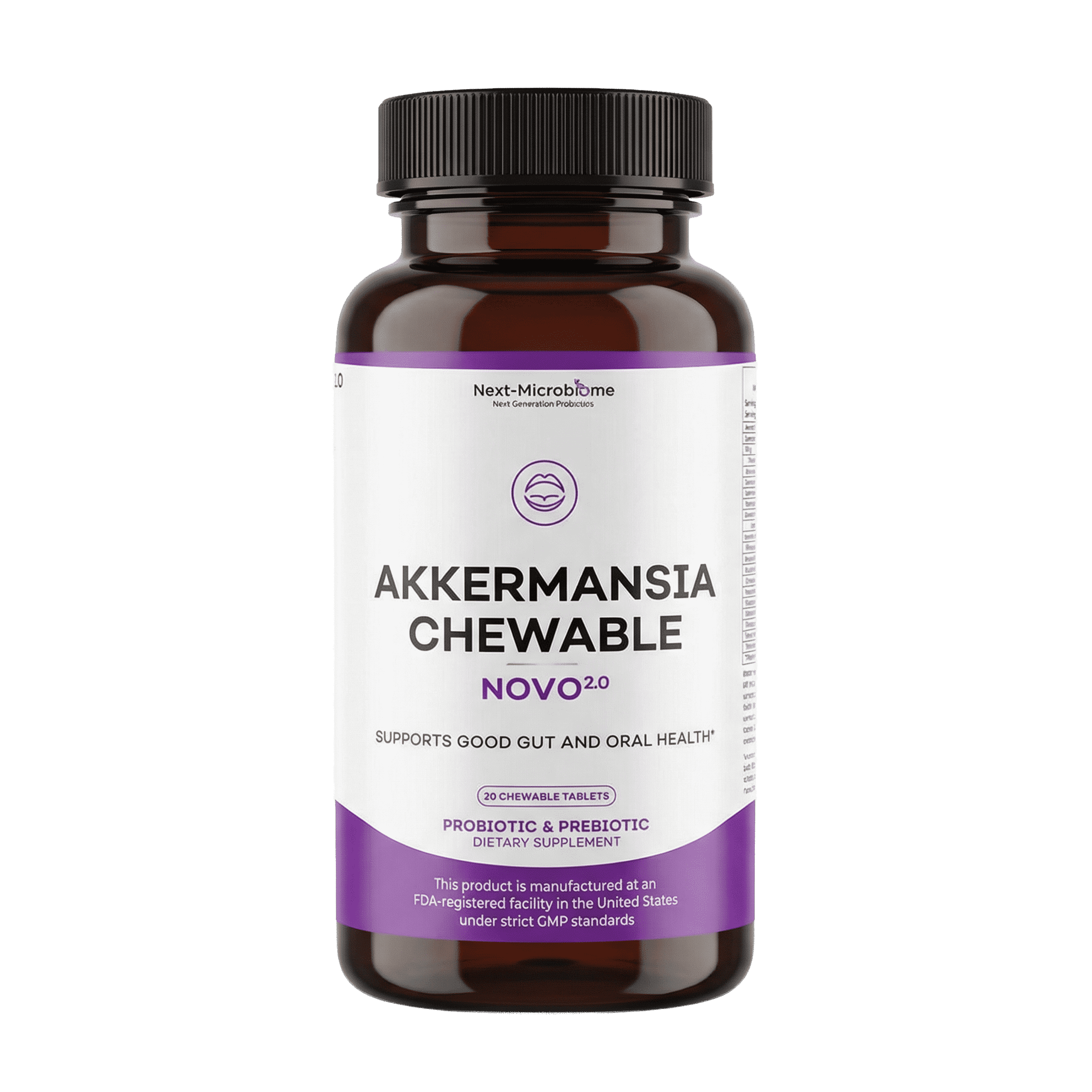
For readers comparing delivery formats, an Akkermansia chewable probiotic formula may be relevant when the goal is to support oral-gut signaling, mucosal contact, and microbiome communication as part of a broader gut barrier strategy.
Scientific References
Chelakkot C, et al.
Mechanisms regulating intestinal barrier integrity and its pathological implications.
Experimental & Molecular Medicine (2018).
PMID: 30115904
Koh A, et al.
From Dietary Fiber to Host Physiology: Short-Chain Fatty Acids as Key Bacterial Metabolites.
Cell (2016).
PMID: 27259147
Plovier H, et al.
A purified membrane protein from Akkermansia muciniphila improves metabolism in obese and diabetic mice.
Nature Medicine (2017).
PMID: 27892954
Bischoff SC, et al.
Intestinal permeability – a new target for disease prevention and therapy.
BMC Gastroenterology (2014).
PMID: 25407511
Written by Ali Rıza Akın
Microbiome Scientist, Author & Founder of Next-Microbiome
Ali Rıza Akın is a microbiome scientist with nearly 30 years of experience in translational biotechnology, systems biology, and applied microbiome research, spanning discovery, preclinical development, and clinical-stage translation.
His work focuses on how microbial ecosystems interact with human physiology, including:
-
Gut barrier function and intestinal permeability
-
Mucus-associated microbiota (Akkermansia-related systems)
-
Oral–gut microbiome axis
-
Short-chain fatty acids (SCFAs) and metabolic signaling
-
Circadian rhythm–microbiome interactions
-
Clinical Research Contributions
He has contributed to multiple clinical-stage microbiome programs, supporting bacterial strain discovery, optimization, and formulation design across different therapeutic areas, including:
Active Ulcerative Colitis (Inflammatory Bowel Disease)
Hyperoxaluria (Oxalate Metabolism Disorder)
Microbiome-driven gut health and inflammatory conditions
These studies were part of broader clinical development programs evaluating microbiome-based approaches. His contributions focused on the early-stage scientific and translational pipeline, including strain discovery, functional optimization, and multi-strain formulation design.
Scientific Contributions:
Ali Rıza Akın is the discoverer of Christensenella californii, a bacterial species associated with microbiome diversity and metabolic health.
He is a contributing author to scientific publications and Bacterial Therapy of Cancer (Springer), and the author of Bakterin Kadar Yaşa: İçimizdeki Evren: Mikrobiyotamız.
Approach:
His work emphasizes evidence-based microbiome science, long-term safety, and a systems-based understanding of how microbes influence human health.
The content provided is for educational and informational purposes only and does not replace professional medical advice, diagnosis, or treatment.

Is Leaky Gut Real? What Science Actually Supports
Gut Barrier Health: What Intestinal Permeability Really Means and Why It Matters
Related Posts

Why Do You Wake Up at 3 A.M.? Gut, Cortisol, Blood Sugar, and Sleep Recovery

Can Gut Health Affect Sleep? How the Microbiome May Shape Rest and Recovery

Ozempic Plateau? What Your Gut Microbiome May Be Telling You About Slower Weight Loss

Akkermansia vs Ozempic: Why Gut Balance May Shape GLP-1, Digestion, and Results

GLP-1 Gut Side Effects: Why Bloating and Constipation Happen and What May Help

Best Probiotic for Leaky Gut? Why Gut Barrier Support Differs From Digestive Probiotics

Can You Support Akkermansia Naturally, or Are Supplements Needed?
