



Why Chewable Probiotics are Superior to Capsule Probiotics?
Why Chewable Probiotics Are Superior to Capsule Probiotics
Probiotics are widely used to support gut health, but the delivery format fundamentally changes how probiotics interact with the human microbiome
Most probiotic supplements are designed as capsules that bypass the mouth and dissolve later in the gastrointestinal tract. However, emerging research shows that chewable probiotics interact with the oral microbiome, mucosal immune system, and oral–gut axis before reaching the intestines — activating biological pathways that capsules largely bypass.
Understanding these mechanisms requires looking at the microbiome as a connected system. Our Akkermansia microbiome guide explores how microbes such as Akkermansia muciniphila support gut barrier integrity, digestive wellness and metabolic signaling, and broader microbiome balance.
This article explains why chewable probiotics can outperform capsules by examining oral–gut axis biology, immune priming, and clinical outcomes, using only validated scientific evidence.
Summary
Chewable probiotics activate the oral microbiome and mucosal immune system before reaching the gut, engaging the oral–gut axis. This early microbial interaction may improve immune signaling, microbiome stability, and probiotic effectiveness compared with capsule delivery formats.
Frequently Asked Questions About Chewable vs Capsule Probiotics
1. Are chewable probiotics more effective than capsules?
In many contexts, yes. Chewable probiotics interact with oral microbiota and mucosal immunity before reaching the gut, while capsules bypass this upstream signaling (PubMed, 2021; Frontiers in Microbiology, 2022).
2. Why does the oral microbiome matter for gut health?
This question is central to current research because oral microbiome gut health is increasingly understood as a connected system, with oral microbial activity and immune signaling influencing downstream gut responses.
3. Do capsule probiotics still work?
Capsules can be effective in specific contexts, but they omit oral immune and microbial engagement, which may limit their biological reach.
4. Who benefits most from chewable probiotics?
Individuals with digestive sensitivity, immune stress, oral–gut axis imbalance, or difficulty swallowing capsules often benefit from chewable formats.
5. Are chewables more effective?
Chewable probiotics effectiveness may vary by strain and individual microbiome.
6. Do they survive stomach acid?
Survival depends on formulation and strain resilience.
7. Who benefits most?
Individuals targeting oral microbial support or seeking easier compliance.
1. The Oral–Gut Axis: Where Chewable Probiotics Begin Working
Chewable probiotics start interacting with the body in the mouth, not after gastric passage.
The oral cavity is an active immune and microbial environment. A study indexed on PubMed (PMID: 33749084) demonstrated that probiotic lozenges altered oral microbial composition and mucosal immune markers—effects that cannot occur when probiotics are delivered exclusively in capsule form.
By engaging oral microbiota, chewable probiotics initiate upstream immune and microbial signaling that shapes downstream gut responses. Capsules, by design, bypass this biological checkpoint.
Oral–Gut Axis & Delivery Format
The oral microbiome influences downstream microbial signaling. Emerging studies suggest that the effectiveness of chewable probiotics may relate to early microbial contact and immune signaling through the oral–gut axis.
Delivery format may influence compliance and colonization patterns.
Explore our oral–gut axis article for additional context.
Emerging next-microbiome models suggest delivery format may influence microbial signaling more than previously understood.
Comparison
|
Feature |
Chewable |
Capsule |
|
Oral Interaction |
Yes |
No |
|
Compliance |
High |
Moderate |
|
Acid Protection |
Strain Dependent |
Strain Dependent |
Scientific References
-
Schmidt et al., 2019
Oral microbiome interactions with systemic health.
Nature Reviews Microbiology. -
Kitamoto et al., 2020
The oral–gut microbiome axis in health and disease.
Nature Reviews Immunology. -
Hill et al., 2014
Expert consensus on probiotics.
Nature Reviews Gastroenterology & Hepatology. -
Zmora et al., 2018
Personalized colonization resistance of probiotics.
Cell.
Oral Microbiota & Gut Health (Deeper Context)
The oral microbiome plays a central role in shaping downstream gut ecology and immune signaling, forming part of a continuous host–microbe communication network from the mouth to the colon.
For a deeper explanation of how the oral microbial community influences gut barrier resilience, immune priming, and overall microbiome dynamics, see Oral Microbiota & Gut Health: How the Mouth Shapes the Entire Microbiome.
For a broader systems-level view of how the oral microbiome connects to gut health, the gut–brain axis, and microbiome development, see the Human Microbiome Hub.
For readers exploring broader topics such as leaky gut and microbiome support, the most relevant concepts in this article are oral–gut signaling, mucosal immune priming, and gut barrier resilience.

2. Clinical Evidence Supporting Chewable Probiotic Formats
Beyond mechanistic reasoning, clinical outcomes support chewable delivery.
A randomized controlled trial published in Frontiers in Microbiology (2022) evaluated a probiotic chewable tablet in children with functional constipation. Participants receiving the chewable probiotic experienced faster improvements in stool frequency and consistency than those receiving placebo.
While this study focused on pediatric populations, it provides direct clinical evidence that chewable probiotic formats can produce measurable gastrointestinal benefits, supporting the functional relevance of oral exposure.
3. Immune Priming and Mucosal Signaling
The oral cavity contains immune tissues that produce secretory IgA and coordinate mucosal immune responses.
By interacting with oral mucosa, chewable probiotics influence immune signaling pathways that extend beyond the mouth. This early immune priming helps explain why chewable formats may generate broader physiological effects than capsules, even when similar probiotic strains are used.
These immune interactions are supported by observed changes in oral immune markers following probiotic lozenge use (PubMed, 2021).
4. Functional Advantages Over Capsule Probiotics
Chewable probiotics offer several biologically meaningful advantages:
-
engage the oral–gut axis
-
interact with mucosal immunity early
-
provide upstream microbial signaling
-
support faster functional responses
-
improve usability and adherence
Capsule probiotics remain useful tools, but they cannot replicate oral microbial engagement, which appears to be a distinct biological advantage of chewable formats.
Practical Applications: When Chewable Probiotics Make Sense
Chewable probiotics may be especially appropriate for:
-
digestive sensitivity
-
immune resilience support
-
oral–gut axis modulation
-
individuals who struggle with swallowing capsules
They are not universally superior in every scenario, but biologically distinct in ways capsules are not.
Practical Probiotic Formulations Aligned With Oral–Gut Biology
Because the mechanisms described above involve oral microbiota engagement and mucosal immune signaling, some probiotic formulations are intentionally designed in chewable form.
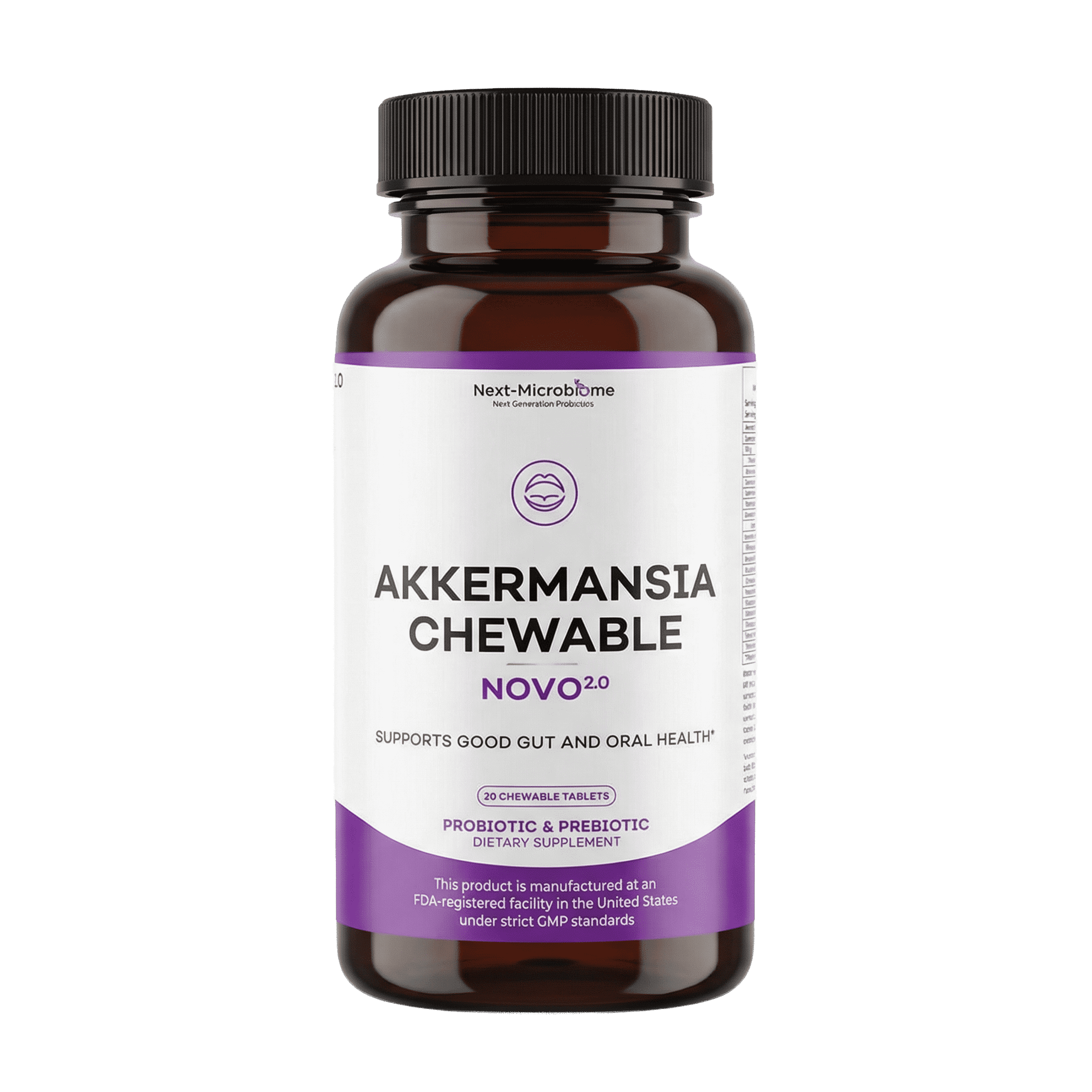
One example is Akkermansia Chewable (Novo 2.0), a chewable probiotic formulated to support oral–gut axis communication, gut barrier and intestinal lining health, and microbiome balance through its delivery format and strain selection. Such formulations may complement dietary, lifestyle, and circadian strategies that support microbiome-driven digestive and metabolic resilience rather than acting as standalone treatments.
Conclusion
Chewable probiotics are not simply a convenience-focused alternative to capsules. They represent a biologically different delivery strategy.
By engaging the oral–gut axis, interacting with mucosal immunity, and demonstrating clinical benefits, chewable probiotics often outperform capsules in real-world use.
As microbiome science advances, delivery format should be considered a core design element, not an afterthought, especially as researchers continue exploring broader themes such as the oral–gut axis and longevity.
Scientific References
-
Probiotic lozenges and oral microbiota modulation. PubMed (2021).
-
Impact of a probiotic chewable tablet on gastrointestinal outcomes: randomized controlled clinical trial.
Frontiers in Microbiology (2022).
Written by Ali Rıza Akın
Microbiome Scientist, Author & Founder of Next-Microbiome
Ali Rıza Akın is a microbiome scientist with nearly 30 years of professional experience in biotechnology, translational research, and microbiome-driven health innovation, spanning academic research, Silicon Valley biotech, and applied product development.
His work focuses on oral–gut axis biology, gut barrier integrity, microbial metabolite signaling (including short-chain fatty acids), mucosal immunity, and host–microbiome communication. A central theme of his research and educational writing is that delivery format, microbial ecology, and host signaling pathways shape the effectiveness of probiotics in real-world settings beyond CFU counts or marketing claims.
Ali Rıza Akın is the discoverer of Christensenella californii, a human-associated bacterial species linked to metabolic resilience and mucosal health. He is the author of Bakterin Kadar Yaşa: İçimizdeki Evren and a contributing author to Bacterial Therapy of Cancer (Springer, Methods in Molecular Biology).
As the founder of Next-Microbiome, he bridges fundamental microbiome science and practical application, emphasizing evidence-based probiotic strategies that prioritize oral–gut signaling, gut barrier resilience, and host response over isolated-strain claims.
All content is provided for educational purposes only and does not replace personalized medical advice. Readers should consult qualified healthcare professionals for individual health decisions.
How Akkermansia muciniphila Supports Gut Barrier, Immunity, and Metabolism
How to Naturally Boost Akkermansia muciniphila for Gut Health and Wellness
Related Posts

Why Does GLP-1 Cause Bloating and Constipation, and How Can You Ease It Naturally?

Which Probiotics May Help Support Leaky Gut and the Gut Barrier?

Can You Support Akkermansia Naturally, or Are Supplements Needed?

How Does Akkermansia Support Natural GLP-1 and Metabolic Regulation?

What Does Science Say About Akkermansia for Gut Health?

Why Is Akkermansia muciniphila Important for Gut Barrier Support?

How Long Does Akkermansia Take to Work?
